

Machu Picchu Train Guide · Updated October 9, 2026
PeruRail vs Inca Rail in 2026: What to Know Before Booking for 2027
A practical comparison of train classes, schedules, departures from Cusco and Ollantaytambo, fares, luggage, scenic experiences and the latest changes affecting travel in 2027.
Confirmed 2027 booking update
PeruRail officially opened 2027 train ticket sales on September 22, 2026, including Expedition, Vistadome and Vistadome Observatory. This is a train ticket sale, not a guarantee of admission to the Machu Picchu archaeological site.
Inca Rail advertises 2027 reservations on its website; check live dates and frequencies before making plans. Official PeruRail announcement.
New October 2026 operating change
PeruRail announced temporary disembarkation and transfer arrangements affecting services 34, 32 and 304 from October 8 through December 31, 2026, involving Pachar and Poroy on specific itineraries. Do not assume these changes remain in effect throughout 2027; confirm the exact boarding and drop-off instructions on your ticket. Read the operating notice.
| Current status | 2026 information | 2027 outlook |
|---|---|---|
| PeruRail tickets | Routes and scheduled services are published | 2027 ticket sales officially open |
| Inca Rail tickets | Voyager, 360°, Prime and premium products advertised | 2027 booking promoted; confirm exact train and date |
| Station operations | Selected temporary changes from Oct 8–Dec 31 | Subject to new notices and season |
| Train prices | Dynamic prices and limited-time promotions | Use an actual date-specific quotation |
| Machu Picchu entrance | Separate Ministry of Culture ticket | Must be independently confirmed |
The difference between PeruRail and Inca Rail becomes much less important at 5:30 in the morning.
At that hour, what matters is whether you are standing at the correct station.
That sounds obvious until you realize that a ticket described as “Cusco to Machu Picchu” may involve a bus from Cusco followed by a train from the Sacred Valley, while another service may depart by rail from San Pedro, Poroy or Ollantaytambo depending on the operator, season and schedule.
And this is where many comparisons go wrong.
They compare:
PeruRail Vistadome vs Inca Rail Voyager
or
PeruRail Expedition vs Inca Rail 360°
as though the company name alone determined the experience.
It does not.
The useful comparison is:
schedule → departure point → train category → price → scenery → included service.
For most travelers, my short answer is:
Choose PeruRail when schedule flexibility and a wider choice of stations matter most. Choose Inca Rail when its particular departure time or 360°/Prime product fits your itinerary better. For a scenic upgrade, compare PeruRail Vistadome or Vistadome Observatory directly with Inca Rail The 360°, rather than simply comparing the two companies.
PeruRail currently markets Expedition, Vistadome and Vistadome Observatory for Machu Picchu, alongside the luxury Hiram Bingham experience, while Inca Rail currently lists The Voyager, The 360°, The Prime, The First Class and The Private.

PeruRail vs Inca Rail at a glance
| Priority | Better place to start |
|---|---|
| Lowest practical fare | Compare Expedition and Voyager |
| Most timetable/station flexibility | PeruRail |
| Panoramic train | Vistadome / 360° |
| Open-air observation experience | Vistadome Observatory / 360° |
| Premium but below full luxury | Inca Rail Prime / PeruRail Vistadome Observatory |
| Full luxury | Hiram Bingham / Inca Rail First Class |
| Private carriage | Inca Rail The Private or PeruRail charter options |
| Starting in Ollantaytambo | Either |
| Starting in central Cusco | Check the exact service, not just the operator |
| One-day Machu Picchu trip | Prioritize schedule |
| Two-day Machu Picchu trip | More freedom to choose by train experience |
| Photography | Daylight Vistadome Observatory or 360° |
| Budget traveler | Whichever Expedition/Voyager departure is cheaper and fits the ticket |
The most important point is already visible in that table:
there is no universal winner.
The best train is often the train that fits your Machu Picchu entrance without creating a bad connection.
What is the real difference between PeruRail and Inca Rail?
Both companies operate tourist transportation toward Machu Picchu Pueblo, also called Aguas Calientes, from where travelers continue by bus to the archaeological sanctuary. Both sell multiple service levels rather than one uniform train product.
Where they differ most noticeably is in their network and product structure.
PeruRail operates a broader mix of stations and services. Its current information lists Machu Picchu departures or travel combinations associated with stations including Wánchaq, San Pedro, Poroy, Ollantaytambo and, for some products, Urubamba. PeruRail also says it operates a broad selection of daily departures to or from Machu Picchu across its wider network.
Inca Rail is more concentrated around Ollantaytambo–Machu Picchu Pueblo, while its Cusco option typically uses a bimodal structure: bus from Cusco to Ollantaytambo followed by train to Machu Picchu Pueblo. Inca Rail’s current train guide identifies Ollantaytambo as its principal rail departure point and its Cusco service as a bus-plus-train journey.
That distinction can matter more than seat upholstery.
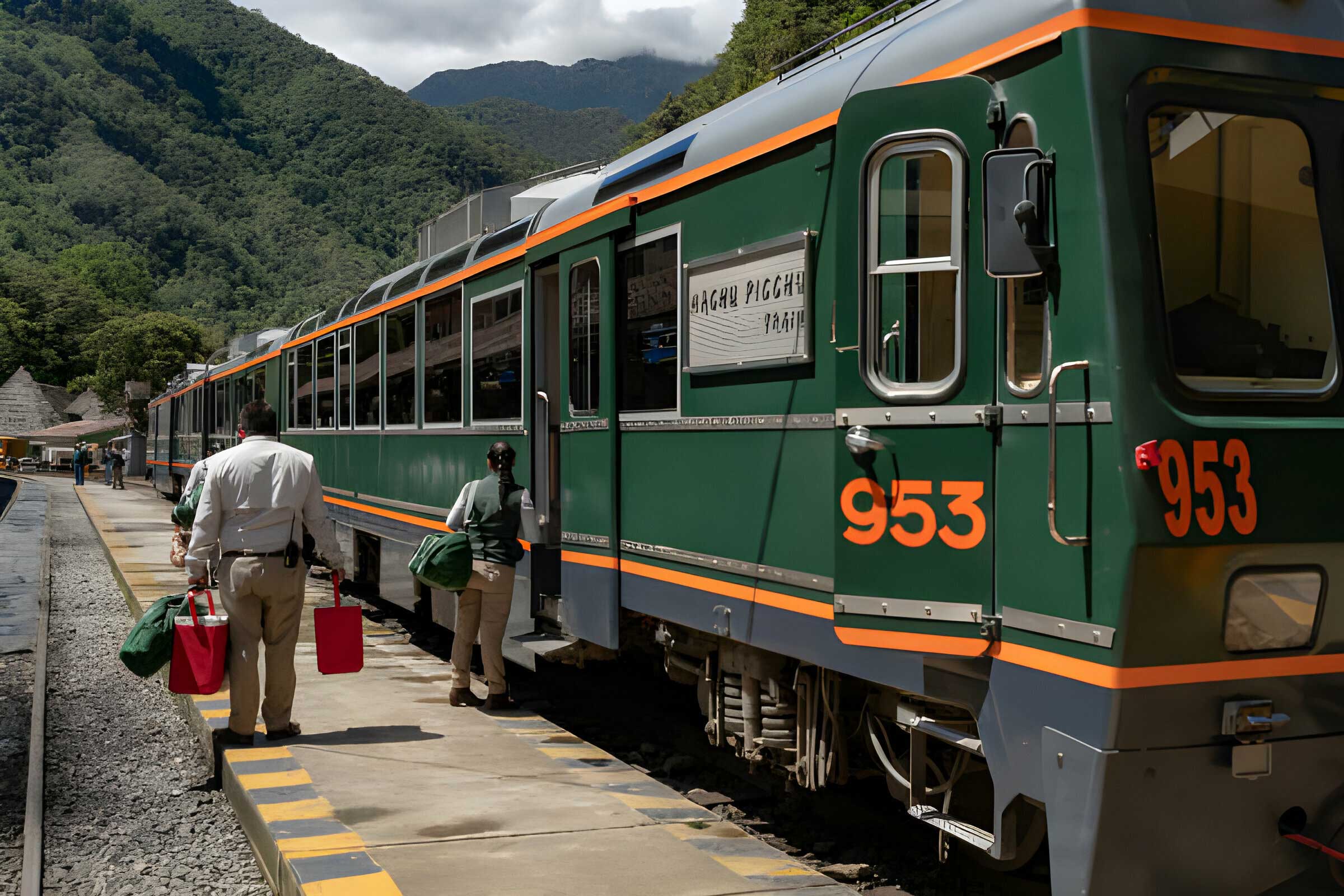
PeruRail Expedition vs Inca Rail Voyager: which basic train is better?
This is the comparison most budget-conscious travelers should make.
PeruRail Expedition
PeruRail positions Expedition as its essential/practical Machu Picchu product.
Current onboard features include:
- Large windows.
- Inca-inspired interior design.
- Ambient music.
- Interpretative audio content.
- Multiple daily schedules.
- Snacks and drinks available for purchase rather than included as a full premium service.
The word “basic” can be misleading.
You are not traveling in an urban commuter carriage.
Expedition is still designed specifically for the tourism market.
What you are mostly giving up compared with higher categories is the more immersive panoramic roof-window arrangement, included refreshments and additional entertainment.
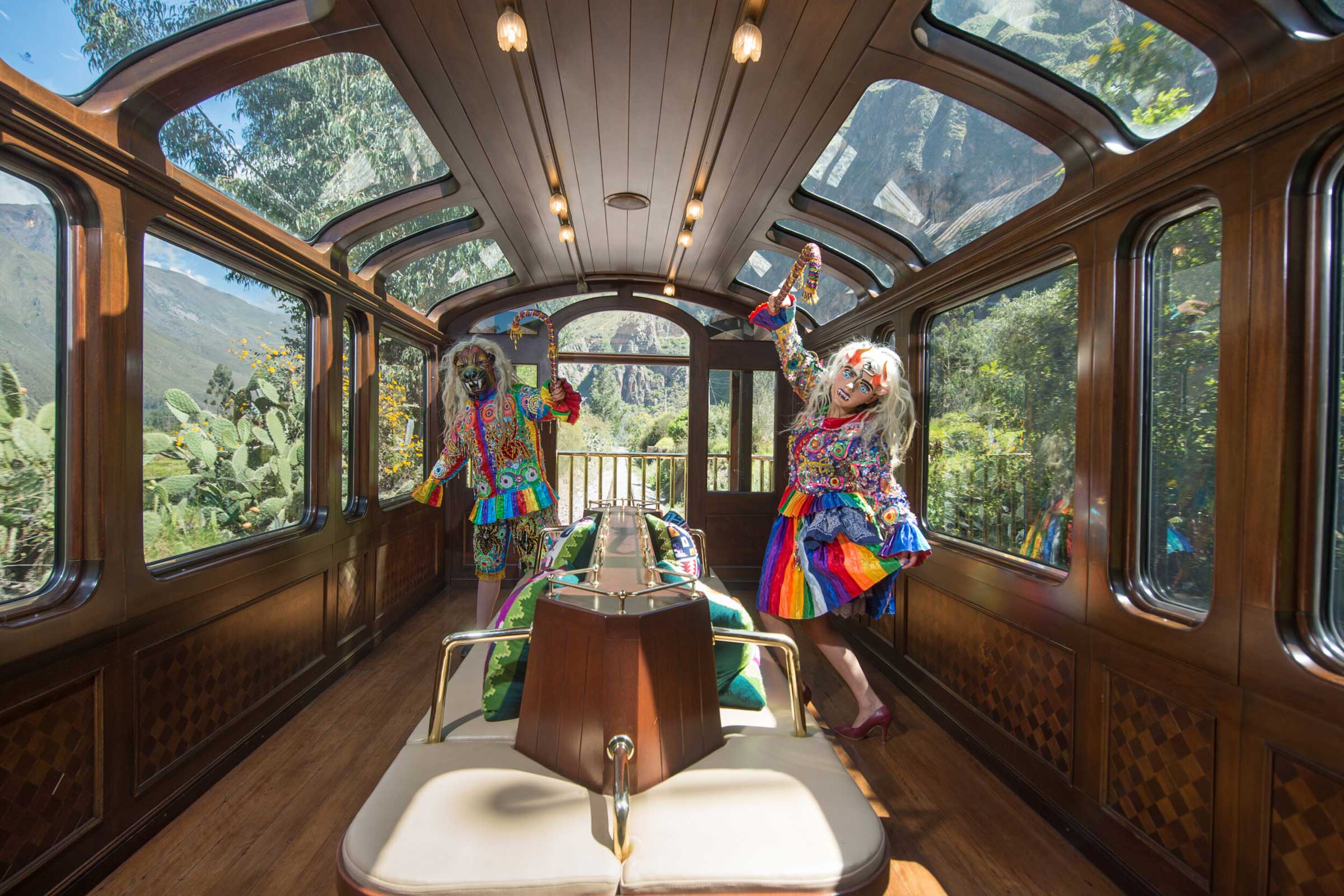
Inca Rail The Voyager
The Voyager fills a similar role for Inca Rail.
Inca Rail describes it as an accessible and practical experience with wide windows, comfortable seating, ambient music and cultural elements. Snacks and beverages can be available for purchase depending on the service.
That makes this the fairest entry-level comparison:
Expedition ≈ Voyager
Not:
Expedition vs The 360°.
Which would I choose?
Whichever has the better schedule.
At this level, I would not pay significantly more simply because one logo appeals to me more.
If Expedition leaves at a time that fits your Machu Picchu entrance perfectly, choose Expedition.
If Voyager saves you an awkward two-hour wait or allows a more comfortable return, choose Voyager.
Schedule is the upgrade.
What about PeruRail Vistadome?
Vistadome is where the railway itself starts becoming a meaningful part of the sightseeing day.
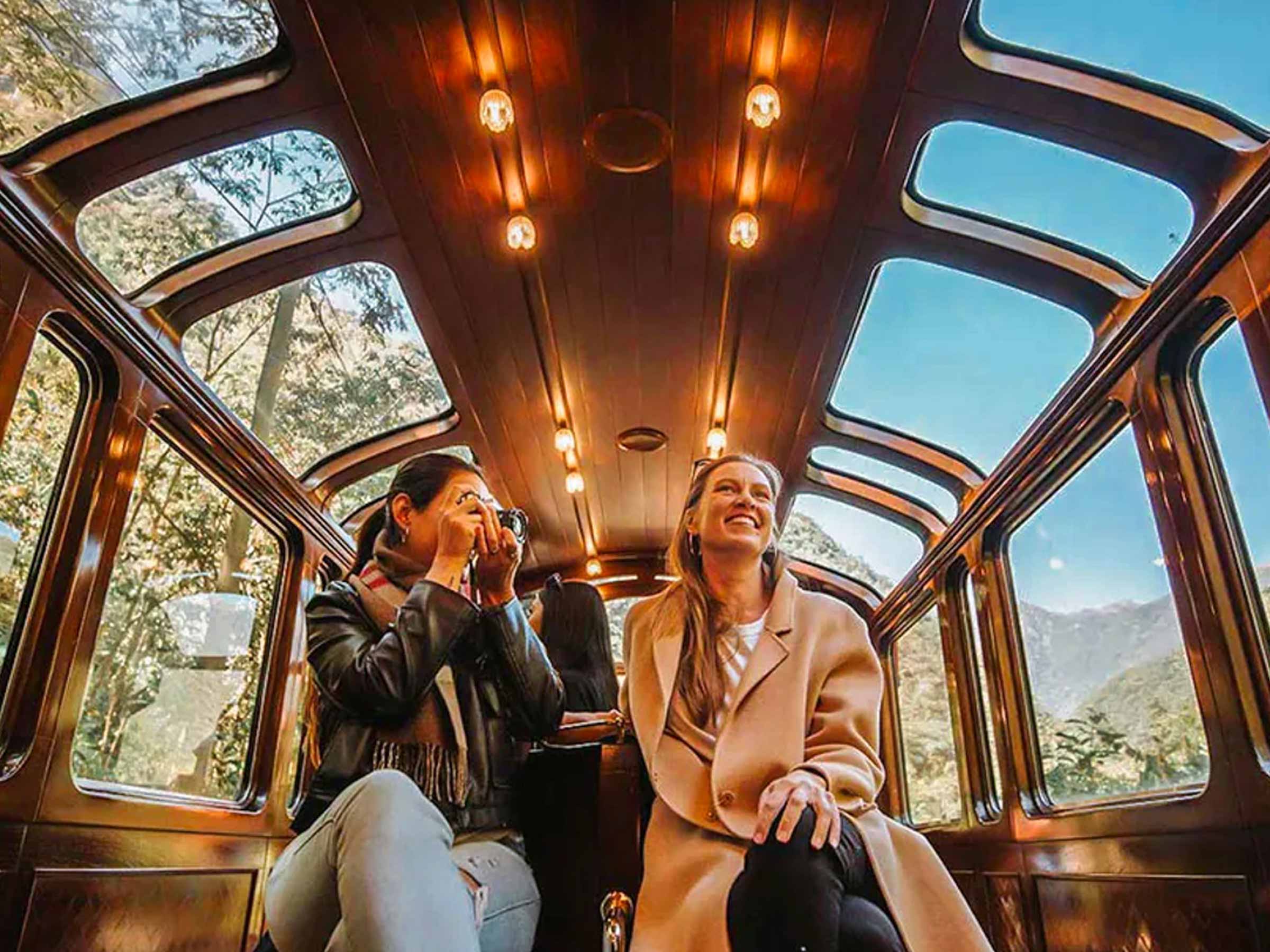
PeruRail’s current Vistadome product includes large side and roof panoramic windows, an onboard snack, interpretative audio content and cultural presentations. On return journeys from Machu Picchu, PeruRail currently advertises traditional entertainment and a baby-alpaca clothing presentation.
The value is most noticeable during daylight.
From Ollantaytambo, the railway follows the Urubamba/Vilcanota corridor as the valley becomes progressively narrower and greener.
You see agricultural fields.
Rock walls begin closing around the railway.
The river remains beside you for long sections.
Eventually the dry Sacred Valley environment begins changing into the humid vegetation associated with the Machu Picchu area.
A panoramic window helps you notice that transition.
Is Vistadome worth paying more than Expedition?
Sometimes.
But not automatically.
Suppose you have these two options:
Expedition at 8:00 a.m.
and
Vistadome at 6:40 p.m.
If landscape is the reason you are paying the premium, the daytime Expedition may actually deliver more visual value than a panoramic train running largely after dark.
That is the small detail train-category comparisons usually miss.
A panoramic train is only as panoramic as the available daylight.
So before upgrading, check sunset time and the actual train schedule.
This matters especially on the return from Machu Picchu.
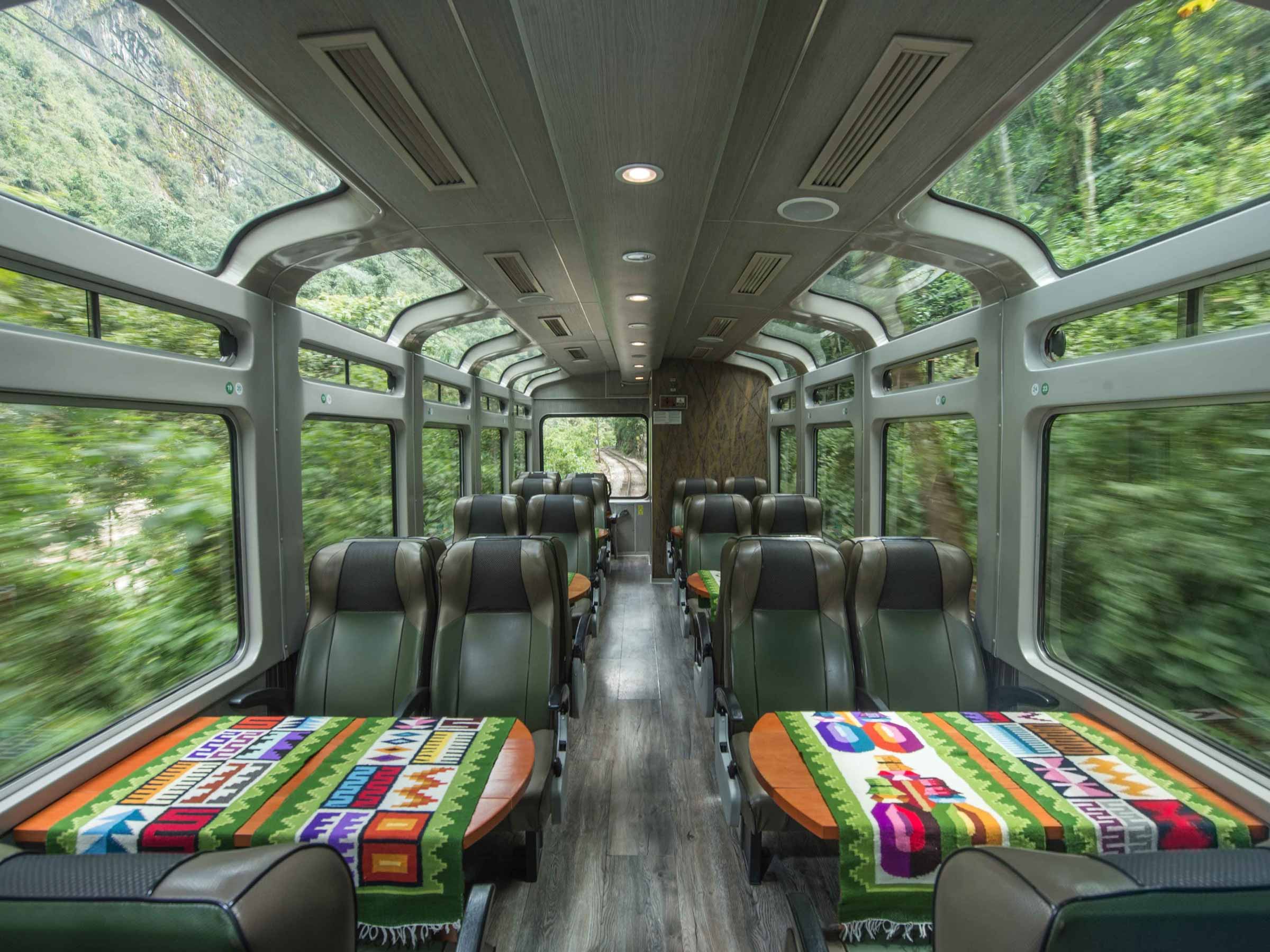
PeruRail Vistadome Observatory: the bigger scenic upgrade
Vistadome Observatory moves beyond panoramic windows.
PeruRail currently includes an open-air observatory carriage, panoramic viewing, live traditional music and dance, snacks and drinks, an audio tour and onboard cultural entertainment.
This is the PeruRail product I would consider when someone says:
“The railway itself is part of my Machu Picchu experience.”
The open section changes the journey.
You can hear the river.
Feel the temperature change.
Photograph outside without shooting through reflective glass.
That is a more meaningful upgrade than simply receiving a different snack.
Best use
Choose Vistadome Observatory for:
- First-time visitors.
- Photographers.
- Couples.
- Travelers celebrating something.
- Anyone making the journey during daylight.
- People who enjoy onboard entertainment.
When I would skip it
If you are returning late after a demanding Machu Picchu day and expect to sleep most of the journey, paying substantially more for an observatory carriage makes less sense.
That is where an asymmetric booking becomes interesting.
The trick many travelers overlook: use different trains in each direction
You do not need to buy the same category both ways.
One of my favorite combinations is:
outbound panoramic → return standard
For example:
Vistadome or 360° to Machu Picchu → Expedition or Voyager back
Why?
Because on the journey toward Machu Picchu you are rested, awake and watching the landscape.
On the return, particularly after walking Machu Picchu and taking the bus back to town, many travelers mainly want:
a seat, a bottle of water and Cusco.
Spending your train budget unevenly can therefore produce better value than purchasing premium service in both directions.
The same logic works in reverse if the available outward train is before sunrise but the return runs through the Sacred Valley during daylight.
Inca Rail The 360°: the real competitor to Vistadome Observatory
This is the Inca Rail train I would compare most directly with PeruRail’s upper panoramic products.
Inca Rail’s current 360° service features large panoramic windows and an open-air observation car intended to provide a more immersive view of the Andes. The operator also advertises Andean-inspired snacks and cultural entertainment as part of the experience.
For a first-time traveler, The 360° is probably Inca Rail’s most immediately understandable upgrade.
You are paying for something visible:

better interaction with the landscape.
The 360° vs Vistadome
| Feature | PeruRail Vistadome | Inca Rail 360° |
|---|---|---|
| Large panoramic windows | Yes | Yes |
| Roof-level views | Yes | Yes |
| Snack | Included | Product-dependent/included according to selected service |
| Cultural content | Yes | Yes |
| Open-air observation area | Standard Vistadome: no dedicated equivalent | Yes |
| Multiple PeruRail station options | Advantage PeruRail | More concentrated |
| Best use | Scenic rail trip | Scenic rail trip |
The 360° vs Vistadome Observatory
This is a closer comparison.
Both emphasize:
- Panoramic scenery.
- Open-air viewing.
- Cultural elements.
- A journey that feels more like an excursion than simple transportation.
At that point, I would choose according to:
departure time first, price second, company third.
What is Inca Rail The Prime?
The Prime sits in an interesting middle category.
It is not Inca Rail’s entry-level service, but neither is it the same proposition as chartering a private carriage.
Inca Rail currently describes The Prime as a premium product with more spacious interiors, wide views, refined service, live Andean music and a complimentary snack inspired by regional cuisine.
This is the train for a traveler who says:
“I want something noticeably more comfortable, but the journey does not need to become the most expensive part of my trip.”
That is a sensible category.
Prime vs 360°
Choose 360° if views and the observation experience matter most.
Choose Prime if seating, atmosphere and premium service matter more.
There is some overlap, and Inca Rail itself markets both products as upgraded experiences. The decisive difference should be the actual departure and inclusions offered on your specific date.
What is Inca Rail First Class?
This is a genuine luxury product.
Inca Rail currently describes First Class as including:
- Spacious premium interiors.
- Priority-style service.
- Gourmet dining.
- Live Andean music.
- Lounge/social areas.
- An open-air balcony.
- More personalized onboard attention.
This is not the train I would recommend simply because “it has bigger windows.”
You buy First Class because you want the railway journey to become a formal travel experience.
It makes the most sense for:
- Honeymoons.
- Anniversaries.
- Luxury itineraries.
- Travelers for whom cost is secondary.
- People who enjoy long-form dining and rail experiences.
If your main objective is merely to see Machu Picchu, there are far more economical ways to reach exactly the same town.
What about Hiram Bingham?
Hiram Bingham is the luxury benchmark on the PeruRail/Belmond side.
The current PeruRail and Belmond information describes Pullman-style carriages, gourmet meals, live music and an observation experience. PeruRail also advertises integrated Machu Picchu services on applicable bookings, although access to the archaeological site remains subject to Ministry of Culture ticket availability. Belmond explicitly advises travelers to verify Machu Picchu entrance availability before relying on the train booking alone.
This distinction is important.
A USD 500+ luxury train reservation is not a magical way around a sold-out Machu Picchu circuit.
The archaeological capacity is controlled separately.
Hiram Bingham vs Inca Rail First Class
| Priority | Hiram Bingham | Inca Rail First Class |
|---|---|---|
| Fine dining | Excellent | Excellent |
| Live music | Yes | Yes |
| Observation/open-air experience | Yes | Yes |
| Historic luxury-train atmosphere | Stronger emphasis | Contemporary luxury |
| Integrated Machu Picchu services | Available on applicable package, subject to entrance availability | Depends on fare/package |
| Price | Very high | Very high |
| Best for | Iconic luxury rail experience | Premium Inca Rail experience |
At this level, arguing about which is “better value” is almost missing the point.
These are discretionary luxury experiences.
How much do PeruRail and Inca Rail tickets cost?
This is where I would ignore websites that publish one exact number as though it were permanent.
There is no single fixed tourist fare for either operator.
PeruRail states directly that its Machu Picchu fares vary according to train service, route, date and availability. Inca Rail likewise runs frequency-specific pricing and promotions, and its terms state that availability and conditions vary by service.
For planning purposes—not as guaranteed tariffs—recent 2026 fare comparisons suggest approximately these broad one-way ranges:
| Service | Rough planning range* |
|---|---|
| PeruRail Expedition | USD 35–60+ |
| Inca Rail Voyager | USD 35–85+ |
| PeruRail Vistadome | USD 75–145+ |
| Inca Rail 360° | USD 85–145+ |
| PeruRail Vistadome Observatory | USD 95–170+ |
| Inca Rail Prime | Often USD 120–180+ territory |
| Inca Rail First Class | Several hundred dollars |
| Hiram Bingham | Around USD 500+ one way is a reasonable planning benchmark |
*These are reference ranges, not fixed official tariffs. Live fares can fall outside them because of date, frequency, promotions, route, nationality-specific offers and availability. Current operator websites deliberately require travelers to search a specific date to obtain the actual fare. Recent 2026 market comparisons place entry-level services around USD 35–60 and premium panoramic services materially higher.
This is why the correct question is not:
“How much does Vistadome cost?”
It is:
“How much does Vistadome cost on my date, at the time that actually works with my Machu Picchu ticket?”
Why the cheapest fare is sometimes not actually cheaper
Imagine this.
Train A costs $20 less.
But it arrives in Machu Picchu Pueblo too late for the entrance hour you wanted.
Now you need:
- Another hotel night.
- A different Machu Picchu ticket.
- Or a change to the rest of the itinerary.
You saved $20 on the train and damaged a trip worth thousands.
That is why I would always choose in this order:
Machu Picchu circuit → entrance time → train schedule → train category → price.
Not:
lowest train price → everything else.
Which company has more departure flexibility?
PeruRail generally has the advantage here.
The company currently markets services across a larger set of stations and says its network offers more than 32 daily Machu Picchu-related departures. Its current Expedition information includes year-round Ollantaytambo service, seasonal rail service from San Pedro and Poroy, and bimodal options from Wánchaq.
Inca Rail’s railway operation is more concentrated around Ollantaytambo, while its Cusco services use bus connections to reach the railway.
This does not make Inca Rail inconvenient.
It means PeruRail may offer more ways to solve a complicated itinerary.
That is particularly useful when your Machu Picchu entrance time is already fixed.
Does PeruRail leave directly from Cusco?
Sometimes.
But you need to read the ticket carefully.
PeruRail’s current 2026 information distinguishes between several operating patterns.
Its Expedition travel plan lists:
- San Pedro–Machu Picchu: direct rail journey, approximately four hours, currently listed for May–December.
- Poroy–Machu Picchu: approximately three hours by rail, currently listed for May–December.
- Ollantaytambo–Machu Picchu: roughly 1½–2 hours, operating year-round.
- Wánchaq–Machu Picchu: a bimodal bus + train journey, particularly relevant in the January–April operating pattern.
PeruRail also currently uses Pachar as a transfer point on selected bimodal services, so passengers should rely on the itinerary printed for their exact frequency rather than assuming every bus transfers at Ollantaytambo.
That is a very useful 2026 detail.
What does “bimodal” actually mean?
It means you do not travel all the way from Cusco by train.
You travel:
Cusco → bus → railway transfer → train → Machu Picchu Pueblo
PeruRail officially describes its bimodal product as a combination of private bus and train service from Cusco toward Machu Picchu.
Inca Rail also offers a bimodal structure from Cusco, connecting travelers by road to Ollantaytambo before continuing by rail.
This is not necessarily inferior.
In fact, it can simplify logistics because one operator coordinates the two segments.
The mistake is imagining that “Cusco–Machu Picchu train ticket” always means you sit in the same railway carriage from downtown Cusco to Aguas Calientes.
Which operator is better from Ollantaytambo?
This is where the contest becomes much more even.
Both operators serve the main Ollantaytambo–Machu Picchu Pueblo corridor. PeruRail places the journey at roughly 1½–2 hours depending on service, while its broader FAQ uses approximately 1 hour 45 minutes as a typical figure. Inca Rail also bases its principal railway operation from Ollantaytambo.
Once you are sleeping in Ollantaytambo, I would stop thinking about the company first.
Compare:
- Departure time.
- Arrival time.
- Train category.
- Fare.
- Daylight.
- Return schedule.
That is all.
Which side of the train has the best view?
This is one of those questions travelers spend too much time worrying about.
The railway changes direction repeatedly relative to the valley, and the scenery appears on both sides during different sections.
A panoramic train reduces the importance of this decision even further.
I would not reject an excellent train frequency because you could not guarantee a particular side.
The larger decision is whether you are traveling during daylight.
What is the luggage limit?
This one matters.
PeruRail’s current luggage page distinguishes between one backpack of up to 8 kg (100 cm total dimensions) and one carry-on bag of up to 12 kg (115 cm total dimensions). Its FAQ still describes an 8 kg allowance for some services, so review the luggage rules shown on your ticket and contact PeruRail if you intend to carry more than a small backpack.
Inca Rail’s published standard allowance is one bag or backpack of up to 8 kg / 17 lb and 118 cm (46 linear inches) in combined dimensions. Confirm any exception directly with the operator.
This is therefore basically a tie.
What should you do with your main suitcase?
Leave it in:
- Your Cusco hotel.
- Your Sacred Valley hotel.
- Your tour operator’s storage, if provided.
- Another confirmed secure luggage facility.
Travel to Machu Picchu with a small overnight bag.
This is especially easy if you are taking a Machu Picchu Tour by Train 2 Days from $330, where one small bag is usually far more practical than dragging a full international suitcase through Aguas Calientes.
Which train is best for a one-day Machu Picchu trip?
The train with the correct timetable.
This is the category where I care least about company loyalty.
A Machu Picchu day trip from Cusco from $285 compresses:
Cusco transfer + railway + Aguas Calientes + bus + archaeological entrance + guided visit + bus + railway + return transfer
into one day.
There is little room for a badly chosen departure.
For a one-day trip, prioritize:
- Machu Picchu entrance.
- Arrival margin.
- Return schedule.
- Operator.
- Train class.
I would happily take Expedition instead of Vistadome if Expedition produced a substantially better Machu Picchu day.
Which is better for a two-day trip?
This is when train preference becomes more interesting.
If you sleep in Aguas Calientes, you no longer need every transport segment to fit around one narrow visit window.
That gives you freedom to choose:
- A later panoramic train.
- A more leisurely Sacred Valley morning.
- 360° instead of Voyager.
- Vistadome Observatory instead of Expedition.
- Different operators outward and back.
This is the itinerary where I would be more willing to spend money on the railway experience.
Which is better for families?
I would prioritize:
fewest transfers + best timetable.
A premium train is pleasant, but moving two children and four bags between hotel, bus and station creates more stress than slightly narrower windows.
For families, check:
- Exact boarding point.
- Arrival requirement before departure.
- Bimodal transfer.
- Food availability.
- Luggage limits.
- Return time.
A child who has been awake since 4:00 a.m. will probably care less about the logo on the carriage than the adults do.
Which is better for older travelers?
Again, schedule usually matters more.
I would look for:
- Comfortable departure time.
- Fewer rushed connections.
- Easy boarding arrangements.
- Minimal waiting at the station.
- Premium seating if budget allows.
If additional comfort is important, Vistadome, Vistadome Observatory, 360° or Prime can all make sense.
But do not create a 3:30 a.m. hotel departure merely because the nicest train leaves first.
Comfort begins before boarding.
Which train is best for photographers?
My first comparison would be:
PeruRail Vistadome Observatory vs Inca Rail 360°.
Both provide an open-air component and panoramic viewing.
Then I would check the clock.
A 4:30 p.m. daylight train in May can be far more useful photographically than a premium service after sunset.
Also remember one technical detail:
Glass creates reflections.
If photographs matter, an open-air observation area is a real benefit.
That is one of the few upgrades whose value cannot be replicated simply by choosing a window seat.
Which is better for a honeymoon?
This depends on budget.
Moderate splurge
Vistadome Observatory or 360°.
You gain scenery and a more memorable onboard experience without moving immediately into several-hundred-dollar luxury territory.
Higher-end
Inca Rail Prime.
More emphasis on refined comfort and atmosphere.
Full luxury
Hiram Bingham or Inca Rail First Class.
At that level, the journey itself becomes one of the major experiences of the itinerary.
What about food?
This is another place where category matters more than company.
Entry level
PeruRail Expedition offers food and drinks for purchase rather than building a premium meal into the fare.
The Voyager similarly sits at the practical end of the Inca Rail portfolio, with onboard refreshments not equivalent to a full luxury dining service.
Panoramic
PeruRail Vistadome currently includes a snack made with Andean ingredients.
Inca Rail 360° also promotes regional snacks and an enhanced onboard experience.
Premium/luxury
Inca Rail Prime includes a complimentary Andean-inspired snack, while First Class moves into gourmet dining. Hiram Bingham likewise makes gastronomy a major part of the journey.
Do not choose a USD 400 train because you are worried about finding lunch.
Choose it because you actually want the dining experience.
What about onboard entertainment?
PeruRail leans heavily into entertainment on its panoramic products.
Current Vistadome and Vistadome Observatory services advertise combinations of live cultural performances, music and alpaca fashion presentations, particularly on the return journey.
Inca Rail also incorporates cultural storytelling, music and performances across products including Voyager, 360° and premium categories.
Whether that is a benefit is subjective.
Some travelers love it.
Others would rather sit quietly beside the window while the Urubamba River passes below.
If you belong to the second group, do not assume “more entertainment” automatically means “better train.”
Which company has the better service?
I would not make a universal claim.
The service level changes too much within each company.
Comparing PeruRail Expedition with Inca Rail First Class and concluding that Inca Rail has “better service” would be meaningless.
You paid for different categories.
The useful comparison is:
Expedition vs Voyager
Vistadome vs 360°
Vistadome Observatory vs 360°/Prime
Hiram Bingham vs First Class
Once you compare equivalent products, the difference becomes much smaller and itinerary fit becomes more important.
Are the trains reliable?
Both companies are established operators on the Machu Picchu railway corridor, but railway operations in the Andes can still be affected by weather, infrastructure conditions, protests or operational events.
That distinction matters.
A delay does not necessarily tell you that the operator itself is generally unreliable.
For example, Inca Rail issued an official update stating that its services had returned to normal operations as of January 1, 2026 after a temporary suspension, while PeruRail also publishes current operational notices when its service pattern changes.
This is why I would never schedule:
Machu Picchu return train → immediate flight out of Cusco
with almost no buffer.
Mountain transport deserves margin.
How early should you book the train?
PeruRail currently recommends reserving at least 2–4 weeks ahead, especially during high-demand periods, and earlier booking is sensible when your Machu Picchu ticket fixes you to a narrow schedule.
Inca Rail likewise recommends booking early, particularly during the busy May–September period, and notes that many travelers secure seats months ahead.
But I would phrase the rule differently:
Book the train shortly after you have confirmed your Machu Picchu ticket.
If your Circuit 2 admission for July is confirmed six months ahead, there is little strategic reason to wait five months before arranging the train.
Does either company include the Machu Picchu entrance ticket?
Normally, a basic train ticket should be treated separately from the archaeological entrance.
PeruRail explicitly states that standard Expedition and Vistadome tickets do not include normal Machu Picchu admission.
Inca Rail, however, currently sells optional All-Inclusive arrangements that can combine railway travel with Machu Picchu entrance, the Consettur bus and guided service.
Hiram Bingham packages can also integrate Machu Picchu-related services, but entry remains dependent on Ministry of Culture availability.
This is a critical distinction:
train availability does not equal Machu Picchu availability.
Always confirm the circuit.
Can I use PeruRail one way and Inca Rail the other?
Yes, conceptually this is exactly how I would shop.
Do not feel obligated to remain loyal to one operator for the round trip.
You can build, for example:
Inca Rail 360° outward
and
PeruRail Expedition return
provided the dates, stations, luggage arrangements and timings fit.
Or:
PeruRail Vistadome outward
and
Inca Rail Voyager return.
That can produce a better timetable and lower total price.
The only rule is to inspect the transfer points carefully.
Do not accidentally combine a return train ending in Ollantaytambo with a plan that assumes your ticket includes transportation all the way to central Cusco.
The detail that matters after a long Machu Picchu day: where do you actually finish?
This is one of the least glamorous and most useful questions.
At 8:30 p.m., you may not care that your train featured panoramic glass.
You care whether you are:
- At Wánchaq.
- At San Pedro.
- At Poroy.
- In Ollantaytambo.
- At an Inca Rail Cusco shuttle point.
PeruRail’s station options vary by frequency and operating season.
Inca Rail’s current information directs Cusco bimodal passengers through its Cusco transport system connecting with Ollantaytambo, and its published train information identifies Av. El Sol 843 as a Cusco boarding point for applicable shuttle services.
Always read the complete itinerary.
The word Cusco is not a precise station.
PeruRail vs Inca Rail for Sacred Valley travelers
If you are sleeping in Ollantaytambo, both become straightforward.
If you are sleeping in Urubamba, PeruRail may occasionally provide additional routing possibilities depending on the operating service, because Vistadome information currently lists Urubamba among its possible departure stations.
But do not force the hotel choice around the train brand.
Ollantaytambo remains the simplest railway base for most travelers connecting the Sacred Valley with Machu Picchu.
This is also why a Sacred Valley and Machu Picchu 2-Day trip from $380 can be geographically more logical than repeatedly returning to Cusco between the valley and the railway.
PeruRail vs Inca Rail during the rainy season
This is where the service model deserves more attention than the train name.
PeruRail’s current 2026 operating plan uses bimodal arrangements extensively during the January–April period, with Wánchaq-based road connections combined with rail travel.
Inca Rail already builds Cusco service around a road connection toward Ollantaytambo.
For a January or February traveler, therefore, I would check:
What is the actual journey on my exact travel date?
Do not assume the May timetable applies in February.
Which company is cheaper?
Neither one is always cheaper.
That is the answer.
Both use variable pricing, multiple categories and promotions. PeruRail explicitly says fares change by service, travel date, route and availability, while Inca Rail has run multiple 2026 promotions across Voyager, 360° and Prime services, including percentage discounts tied to specific purchase windows and frequencies.
A Voyager can be cheaper than Expedition on one date.
Expedition can be cheaper on another.
A discounted 360° can occasionally narrow the gap with a standard train.
So compare the final fare for the exact frequency, not the marketing category.
Should you pay extra for panoramic windows?
Here is my rule.
Yes, if:
- This is your first trip.
- You travel during daylight.
- The price difference is reasonable.
- You enjoy scenic transport.
- The train journey itself matters to you.
- You are not already spending several days traveling through the Sacred Valley.
No, if:
- The premium train is mostly after dark.
- You are on a tight budget.
- You already spent several days driving through the valley.
- You will probably sleep on the return.
- Upgrading forces you into a worse Machu Picchu schedule.
The landscape does not improve because your ticket costs more.
Your access to it improves.
That difference matters.
My preferred combinations
Best budget combination
Expedition or Voyager in both directions.
Spend the savings on another night, a better Machu Picchu itinerary or another experience.
Best value for a first visit
Panoramic outbound + standard return.
For example:
Vistadome / 360° → Machu Picchu
Expedition / Voyager → return
Best scenic trip
Vistadome Observatory or 360° during daylight.
The open-air component makes the upgrade tangible.
Best premium option without going all the way to luxury
Inca Rail Prime or PeruRail Vistadome Observatory, depending on schedule and fare.
Best luxury
Hiram Bingham if the iconic luxury-rail experience itself is part of your Peru trip.
Inca Rail First Class if its specific schedule and contemporary premium product appeal more.
So which one would I choose?
For an ordinary first-time traveler?
I would start with PeruRail.
Not because the carriage is automatically better.
Because the broader selection of schedules and stations gives me more chances to create a clean itinerary around a fixed Machu Picchu entrance. PeruRail’s current network is materially broader than Inca Rail’s more Ollantaytambo-focused rail operation.
But if Inca Rail offered me:
a 360° departure at the perfect time
while the comparable PeruRail option required an awkward early departure or late return?
I would choose Inca Rail immediately.
That is the point of this entire comparison.
Do not choose the company first. Choose the itinerary first.
Final comparison: PeruRail vs Inca Rail
| Category | PeruRail | Inca Rail |
|---|---|---|
| Entry-level train | Expedition | Voyager |
| Panoramic | Vistadome | 360° |
| Open-air observation | Vistadome Observatory | 360° |
| Premium | Vistadome Observatory | Prime |
| Luxury | Hiram Bingham | First Class |
| Private | Charter possibilities | The Private |
| Station network | Broader | More concentrated |
| Ollantaytambo access | Excellent | Excellent |
| Cusco bimodal service | Yes | Yes |
| Standard luggage allowance | 8 kg | 8 kg |
| Variable pricing | Yes | Yes |
| Best for schedules | PeruRail advantage | Depends on frequency |
| Best operator overall | No universal winner | No universal winner |
The operator product descriptions and current route information support the broad differences summarized above; exact schedules, fares and operating stations remain date-dependent.
The one rule to remember
If you remember nothing else from this comparison, remember this:
Machu Picchu ticket first. Train second. Train company third.
A beautiful Vistadome ticket is useless if it does not match your archaeological entrance.
A discounted Voyager ticket is not a bargain if it forces another hotel night.
And a $500 luxury train cannot create a Machu Picchu circuit that has already sold out.
Start with:
circuit → entrance time → train schedule
and only then decide whether you prefer:
Expedition, Voyager, Vistadome, 360°, Observatory, Prime or luxury.
That is how you get the best train.
Not by choosing the best-known logo.
By choosing the train that makes the rest of the journey work.
Price and schedule note
Train fares and frequencies are dynamic. PeruRail explicitly states that prices vary according to service, route, travel date and availability, while Inca Rail also uses frequency-dependent inventory and promotional fares. The price bands above are therefore intended only for trip budgeting as of 2026, not as guaranteed tariffs. Always confirm the live fare after securing the Machu Picchu date and circuit.
If you need the train to be coordinated with a Machu Picchu entrance rather than purchased as a separate transport ticket, you can contact Machu Picchu Peru Travel at info@machupicchuperutravel.com.
Machu Picchu Peru Travel
Calle Matara N°410, Cusco
Email: info@machupicchuperutravel.com
Phone: +51 971 021 010
Last editorial review: October 9, 2026. All service inclusions, prices, frequencies and transfer arrangements may change. Estimated historical one-way fares in this article are planning references, not guaranteed 2027 quotations.


Leave a Reply