Qorimarca Social Project — Machu Picchu Peru Travel
Machu Picchu Peru Travel

Navigation

Home Presentation Background Objectives Beneficiaries Activities Gallery Voices Team Impact Conclusions FAQ Join the Mission Thanks
Corporate Social Responsibility — Cusco, Perú

Improving Health, Learning
& Values
in Qorimarca

A single extraordinary day in a rural Andean community high in the Cusco region — oral health workshops, joyful mathematics, storytelling circles, and backpacks full of school supplies, all delivered with love by the Machu Picchu Peru Travel team.

Oral Health Fun Math Storytelling School Supplies 43 Beneficiaries
Location
Qorimarca, District of Qorao, Cusco, Perú
Project Director
Tania Huaman — General Manager
Project Type
Corporate Social Responsibility (CSR)
Target Population
Preschool & Primary School Children
Andean school children
Section 1

Presentation

Machu Picchu Peru Travel is a travel agency based in the city of Cusco, dedicated to offering both national and international tourism packages. The agency has spent years connecting travelers from around the world with the majestic Andean landscapes, ancient ruins, and living cultures of the Cusco region.

As part of its Corporate Social Responsibility (CSR) policy, the agency recognizes that the development of sustainable tourism in the Peruvian Andes must be accompanied by an active commitment to the rural communities that inhabit these territories. The roads we travel pass through living communities — communities that are guardians of Andean culture, heritage, and the landscapes our passengers fall in love with every single day.

This document describes the social project carried out in the farming community of Qorimarca, District of Qorao, Province of Cusco, whose central objective was to improve the quality of life of the children of the community through three educational interventions: promotion of oral health, reinforcement of mathematical learning through play-based dynamics, and strengthening of values through storytelling. A fourth complementary activity focused on providing essential school supplies to every participating child.

0
Direct Beneficiaries
0
Activities Delivered
0
Backpacks Given
0
Team Volunteers
Oral Health Promotion

Correct brushing techniques and personal dental supplies for every child.

Fun Mathematics

Reinforcing numeracy skills with play-based, competitive dynamics.

Values Through Storytelling

Classic tales with group reflection to nurture perseverance and inclusion.

Section 2

Background & Justification

2.1 — Community Context

The community of Qorimarca, located in the District of Qorao, is a traditional Andean farming community in the Cusco region. Nestled at altitude, surrounded by terraced hillsides and the timeless rhythms of agricultural life, Qorimarca is home to families who have maintained Andean traditions for generations.

Like many rural communities in the Peruvian Andes, it faces significant limitations in access to basic health services, quality education, and pedagogical materials. The nearest urban centers are difficult to reach, and the resources available to local schools pale in comparison to those found in the city of Cusco just a short distance away.

The educational institutions in these communities — both preschool and primary level — operate with limited resources, restricting the integral development of their students. This context justifies the intervention of private actors such as Cusco travel agencies, which, by virtue of their economic activity linked to Andean cultural heritage, assume a role of giving back to the communities that form part of that very heritage.

Download Full Social Project Document (Español)
Download Full Social Project Document (English)

2.2 — Problems Identified

After an initial assessment of the community, four key dimensions of need were identified — each one demanding a concrete, actionable response. Click on each card to read more details.

Oral Health Click for more
Absence of dental hygiene habits in children; no knowledge of correct brushing techniques; no personal dental supplies available at home or school.
Mathematical Learning Click for more
Difficulty comprehending three-digit numbers (units, tens, hundreds) — a foundational numeracy skill needed for all future mathematical progress.
Values Education Click for more
Limited exposure to storytelling and reflection spaces on values such as perseverance, discipline, and inclusion. Children need more than academics — they need character.
School Materials Click for more
Lack of basic school supplies at the start of the academic year — no notebooks, no pencils, no backpacks. A small gap with a very large impact on learning outcomes.

2.3 — CSR References & Framework for Action

This project is part of a growing tradition of Cusco travel agencies that integrate social responsibility as part of their sustainable business model. Similar organizations have developed interventions in communities such as Chinchero, Pisac, Ollantaytambo, and other Andean localities, prioritizing children's education and health as axes of impact.

Machu Picchu Peru Travel adopts this approach as part of its corporate mission, recognizing that the success of tourism in the Cusco region is directly and inseparably linked to the well-being of the communities that sustain it. When we invest in Qorimarca, we invest in the future of the entire Andean tourism ecosystem.

Tourism is one of the most powerful economic engines in the Cusco region, generating income for thousands of local businesses, guides, artisans, and service providers. Yet the communities closest to the archaeological sites — the very people who maintain the landscapes and traditions that draw visitors — often receive the least direct benefit.

Corporate Social Responsibility in tourism means actively closing this gap. It means that the economic value created by a traveler's visit flows back, in some form, to the people and places that make the experience possible. For Machu Picchu Peru Travel, this is not charity — it is a business philosophy grounded in reciprocity, long-term thinking, and genuine respect for Andean communities.

Section 3

Objectives

3.1 — General Objective

To contribute to the integral development of the children of the Qorimarca community through participatory educational activities aimed at improving their oral health, reinforcing their mathematical competencies, and strengthening their formation in values.

3.2 — Specific Objectives

Hover or tap each card to reveal the full objective.

01
Oral Health Practice
Objective 01
Teach and practice correct tooth-brushing techniques in preschool and primary school children, building a lifelong daily habit.

hover to flip

02
Three-Digit Numbers
Objective 02
Reinforce recognition and use of three-digit numbers — units, tens, hundreds — through play-based and competitive dynamics.

hover to flip

03
Values Through Stories
Objective 03
Transmit values of perseverance, discipline, and inclusion through storytelling with group reflection and active participation.

hover to flip

04
School Supplies
Objective 04
Provide every student with basic school materials — notebooks, pencils, and a backpack — needed for a strong start to the academic year.

hover to flip

Section 4

Target Population & Beneficiaries

The project directly benefited approximately 43 people, with children at both preschool and primary levels at the heart of the intervention. Each group brought unique needs — and unique joy — to the day.

GroupDescriptionEstimated
Preschool childrenAges 3–5, community kindergarten. Full of curiosity and energy — their first formal learning experiences.15children
Primary school childrenAges 6–12, community primary school. At a critical stage for building foundational academic and life skills.20children
Fathers & mothersAttending the school supply delivery session. Their presence and trust were essential to the project's success.8adults
Total direct beneficiaries43
Section 5

Description of Activities

Four activities — three main and one complementary — were executed in a single day. Click each tab to explore every detail, from phases to tables to observed results.

"Healthy Smiles"

Oral Health Workshop

A practical oral hygiene workshop for preschool and primary children. The activity aimed to promote correct dental brushing habits and instill a culture of oral care from an early age — arming every child with their own toothbrush and the knowledge to use it properly.

Good oral health is one of the most foundational aspects of a child's overall well-being and academic performance. A child in pain cannot concentrate. A child who learns healthy habits early will carry them for life.

Development — 3 Phases
Phase 1 — Motivation & Participatory Diagnosis
  • Open dialogue with children on the importance of brushing their teeth.
  • Guiding questions: "Why do we brush our teeth? What tools do we need?"
  • Children identified consequences of not brushing: cavities, food residue build-up, tooth decay and pain.
Phase 2 — Demonstration & Guided Practice
  • The facilitator demonstrated the correct brushing technique, differentiating between upper and lower teeth and proper circular movements (minimum 7 strokes per section).
  • Each child received a personal toothbrush and toothpaste to brush independently under team supervision.
  • Full sequence practiced step-by-step: brushing → water rinse → spit → final rinse.
Phase 3 — Reinforcement of Key Messages
  • Discussion on the impact of candy and sugary food consumption, and the need to brush after every meal.
  • Verbal commitment from children to incorporate daily brushing as a permanent habit.
  • Children took their toothbrushes home — their first personal oral health tools.
Materials Used
MaterialRecipient
Toothbrush (one per child)Each participating child — to keep
Toothpaste (one per child)Each participating child — to keep
Cup with water (one per child)Used during the practice session
Observed Results
Children demonstrated the ability to execute the full brushing sequence independently by the end of the session.
Motivation and enthusiasm were clearly evident — especially when children received their own toothbrush as a personal possession.
Children verbalized commitments to practice brushing daily at home, in their own words and with evident conviction.
"The Great Number Challenge"

Fun Math Workshop

A play-based and competitive dynamic focused on recognizing and understanding three-digit numbers — specifically the concept of units, tens, and hundreds. Mathematical learning was deliberately woven together with games, competition, and extrinsic motivation.

Place value is one of the most important foundational concepts in mathematics. When children understand it intuitively, arithmetic becomes accessible and even joyful. When they don't, a wall goes up that is hard to climb.

Development — 3 Phases
Phase 1 — Conceptual Introduction
  • The teacher presented the concepts of units, tens, and hundreds using concrete examples with large number cards.
  • A portable whiteboard was used for visual demonstration, making each number visible to the whole group.
  • Children were invited to come up and point to the hundreds, tens, and units in sample numbers.
Phase 2 — Paired Competition
Children worked in pairs, racing to correctly identify and arrange three-digit number cards. The teacher asked: "How many units does 745 have? How many tens? How many hundreds?" — and pairs competed to answer first. The excitement was palpable.
Numbers Worked in the Activity
NumberHundredsTensUnits
745745
754754
649649
523523
Phase 3 — Prize-giving & Inclusive Closing
  • Winning pairs received chocolates as recognition of their participation and quick thinking.
  • The facilitator emphasized: all participants would receive a prize at the end — modeling an inclusive, growth-oriented learning environment where effort matters as much as outcome.
Observed Results
Children successfully identified units, tens, and hundreds in all numbers worked during the session.
The competitive dynamic generated high participation and visible enthusiasm from all student groups.
Several cases of tied results occurred, which extended the activity naturally and kept everyone engaged until the very end.
"Learning Together"

Storytelling with Values

An oral storytelling session using classic tales with a focus on values development, reading comprehension, and group reflection. Children were gathered in a circle in the school courtyard, under the open Andean sky, creating an atmosphere of active listening and spontaneous participation.

Stories have always been the most powerful vehicle for transmitting human values across generations. In the Andean tradition, communal storytelling is a living practice. This activity honored that tradition while introducing new narratives about resilience and belonging.

Stories Narrated
StoryValues ExploredTechnique
The Hare & the TortoisePerseverance, discipline, humility, self-confidenceOral narration with gestural dramatization & children's participation
The Ugly DucklingInclusion, acceptance of difference, identity, self-esteemRead-aloud with comprehension questions
Development of Each Story
Story 1 — The Hare & the Tortoise
  • Dynamic oral narration where children physically imitated the movements of the hare and tortoise — sounds, gestures, running in place, slow walking.
  • The narrator introduced concepts like speed, overconfidence, and perseverance organically through the story's progression.
  • Reflective questions at the end: "Why did the tortoise win?""What should we learn from this story?"
  • Children's responses: "Because she wasn't overconfident", "For perseverance", "We must never give up."
  • Central message: "No matter if we are tortoises — if we are perseverant and disciplined, no hare will ever beat us."
Story 2 — The Ugly Duckling
  • Read aloud with expressive intonation, explanatory pauses, and vocabulary carefully adapted to the children's age level. Words like disheveled, awkward, lagging behind, rushes were defined in accessible terms.
  • Participation was encouraged with intercalated questions during narration to test comprehension and keep attention.
  • Group reflection: "Are there different children in your class? Is being different good or bad?"
  • Unanimous response — every hand in the circle went up: "Good! We are all special."
  • Central message: "We are all different — and that makes us special. Being different does not make us bad. We are good, we are better."
Closing of the Storytelling Session
The narrator closed with a reflection on the importance of reading comprehension: "It's not enough to just read and read — we need to understand what we are reading." All participants received chocolates as recognition for their listening and participation.
Complementary Activity

School Supply Kit Distribution

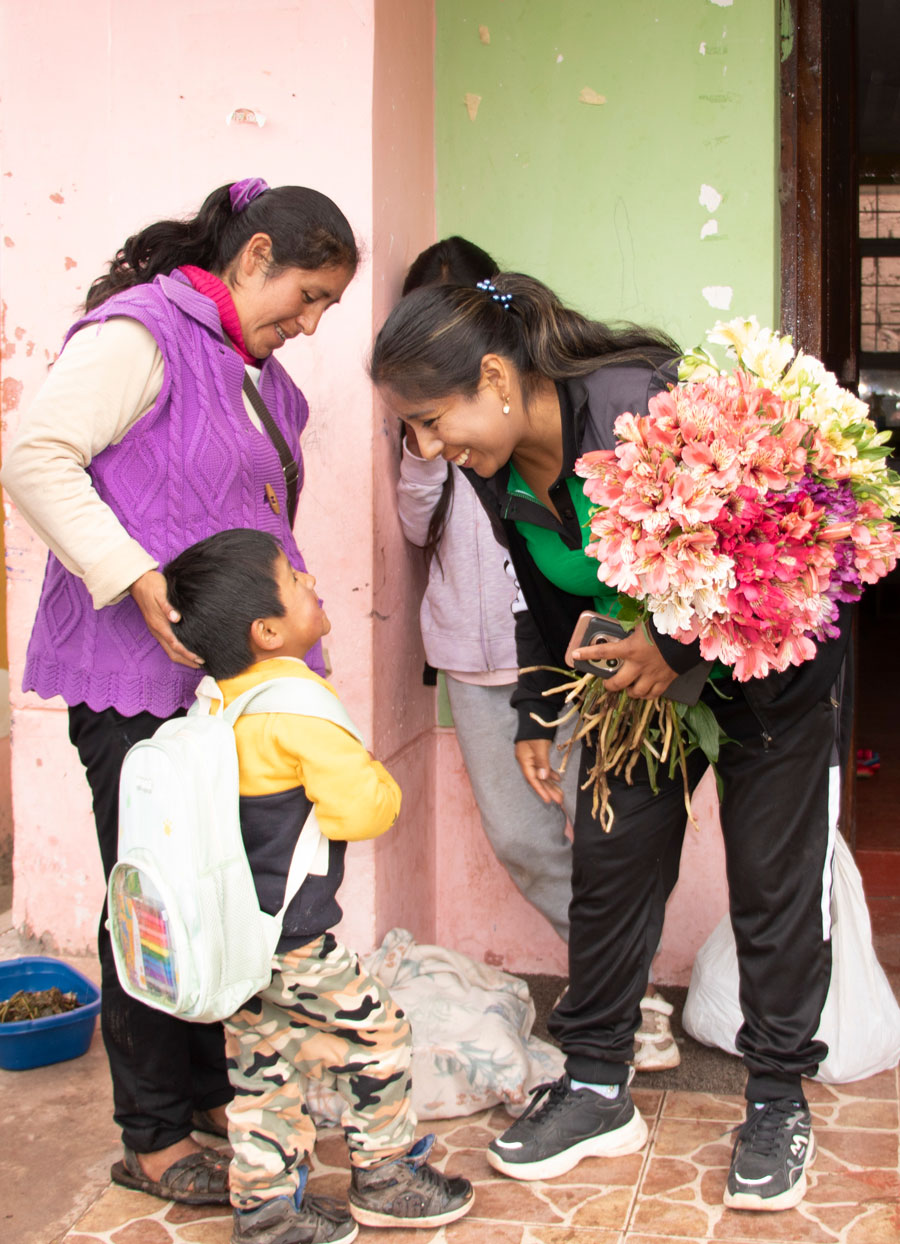
At the close of all pedagogical activities, school supply kits were distributed to each participating child — preschool and primary levels — ensuring every child could begin the academic year with the tools they need.

A backpack is more than an object. For a child in a rural community, receiving a full backpack of school supplies sends a message that matters deeply: someone believes in you. Someone thinks your education is worth investing in.

Kit Contents by Level
MaterialPreschoolPrimary
Notebook(s)✓ (1)✓ (2)
Colored pencils
Markers
Ruler set
Glue stick
Pencil
Eraser
Sharpener
Modeling clay (plastilina)
School backpack
Words from the General Manager

"Our fundamental pillar is social support. We came here to Qorimarca to support this little community school so that the children can have a good start. We hope the school improves, because what we want is for our youngest children to one day become professionals. If we can help, we will — and we will keep doing it, leaving here a commitment to this community."

— Tania Huaman, General Manager

Our fundamental pillar is social support. We came here to Qorimarca to support this little community school so that the children can have a good start. If we can help, we will — and we will keep doing it.

Tania Huaman — General Manager, Machu Picchu Peru Travel

Voices from Qorimarca

What the Community Said

The most meaningful measure of impact is the words of the people who lived the day.

Section 8

Executing Team

Every member participated voluntarily and with full commitment. Click a card to learn more about each person's role.

Tania Huaman
General Manager
View bio
José Manuel Aparicio
Math Teacher
View bio
Diego
Storytelling Facilitator
View bio
César Huaman & Team
Oral Health Facilitator
View bio
Rodrigo Quille & Team
Logistics & Coordination
View bio
Maribel
Community Host
View bio
Section 9

Execution Schedule

All four activities were executed sequentially in a single intervention day at the Qorimarca community school:

1
"Healthy Smiles" — Oral Health
First part of the day  ·  School facilities
2
"Great Number Challenge" — Math
Second part of the day  ·  Outdoor patio
3
"Learning Together" — Storytelling
Third part of the day  ·  Central patio (circle)
4
School Kits & Closing Remarks
Closing of the day  ·  Classroom / patio
Section 10

Resources Used

Human Resources
1 General Manager — coordination & institutional representation
2 Pedagogical facilitators
1 Health facilitator
1–2 Volunteer logistics assistants
Material Resources
Toothbrushes & toothpaste (one per child)
Three-digit number cards & portable whiteboard
Printed story / The Ugly Duckling book
School supply kits with all items
35 school backpacks & chocolate prizes
Section 11

Results & Impact

11.1 — Quantitative Results

0
Oral Health Workshop
0
Brushed Independently
0
Math Dynamics
0
Storytelling Session
0
School Kits
0
Backpacks Delivered

11.2 — Impact Reach (Progress)

Children reached by oral health35 / 35
Children in math activity20 / 35
Children in storytelling35 / 35
Backpacks distributed35 / 35
Families directly engaged8 adults
Total beneficiaries43 / 43

11.3 — Qualitative Results

Oral Health
Children acquired basic knowledge of the correct brushing technique and expressed genuine commitments to practice it daily. They verbalized specific habits they would adopt at home — from brushing after meals to limiting sweet consumption.
Mathematics
Students demonstrated the ability to identify units, tens, and hundreds in three-digit numbers through the play-based activity. Comprehension was visibly reinforced through competition and peer collaboration. The joy was tangible.
Values
Children reflected aloud on perseverance, discipline, and the acceptance of diversity. They connected the messages of the stories to their own everyday experiences and showed deep emotional engagement — especially around the theme of inclusion.
Materials & Community Bond
All children began the school year with the necessary supplies, including a personal backpack. The intervention strengthened the bond of trust between Machu Picchu Peru Travel and the Qorimarca community, opening clear possibilities for future collaborations.
Section 12

Conclusions & Recommendations

12.1 — Conclusions

The intervention demonstrated that companies in the tourism sector in Cusco can play an active and meaningful role in the educational and social development of remote Andean communities. The success of tourism is inseparable from the well-being of the communities that sustain it. This is not charity — it is a shared investment in a shared future.

Play-based and participatory activities generated greater involvement from the children than traditional lecture-style methodologies, confirming the value of hands-on, joyful learning environments for rural primary education. Competition, physical movement, and storytelling are not extras — they are essential.

The delivery of school materials combined with educational activities amplifies the integral impact of the project by addressing both material needs and formative development simultaneously. Neither alone is as effective as both together. A child with new knowledge and a backpack to carry it in starts the year truly ready.

The community's receptiveness — teachers, parents, and children alike — was highly positive, evidencing an unmet demand for this type of social intervention in rural communities throughout the Cusco region. The school opened on a non-working day. Parents attended voluntarily. Children participated with full enthusiasm. This is what demand looks like.
Looking Ahead

12.2 — Recommendations

Continuity
Schedule periodic visits — semi-annual or annual — to Qorimarca to follow up on installed habits and reinforce the learning achieved. Change requires repetition.
Scalability
Replicate the model in other communities along the Cusco tourism corridor where Machu Picchu Peru Travel operates, multiplying social impact across the region.
Strategic Alliances
Establish partnerships with rural health centers to complement the oral health component with basic dental care services — moving from education to treatment.
Documentation
Systematize each intervention with follow-up indicators to measure medium and long-term impact, building an evidence base that can support funding and replication.
Family Participation
Incorporate parents and guardians as active participants in workshops — especially oral health — to ensure habit continuity at home beyond a single intervention day.
Section 13

Frequently Asked Questions

Questions from travelers, partners, and supporters about the project and how to get involved.

Qorimarca is a rural Andean farming community in the District of Qorao, Province of Cusco, Peru. It is located at altitude in the mountainous terrain surrounding the city of Cusco — part of the broader landscape that makes this region one of the most visited in South America. Like many communities in the region, it is not on the main tourist circuit, which is precisely why targeted social investment matters.

The project was entirely funded by Machu Picchu Peru Travel as part of its Corporate Social Responsibility budget. All materials — dental kits, school supplies, backpacks, prizes — were purchased and donated by the company. The entire team participated voluntarily, on a non-working day, without compensation. This is a fully internally financed community initiative.

Yes. General Manager Tania Huaman made a public commitment to the community on the day of the project: "If we can help, we will, and we will keep doing it." The team's recommendation is to schedule semi-annual or annual follow-up visits to reinforce habits and learning, and to assess new needs. Qorimarca is the beginning, not the end.

Absolutely. Machu Picchu Peru Travel is actively developing ways for travelers to engage with community projects as part of their Cusco experience — from joining a supply donation drive before their trip to participating in community visits. If you are interested in supporting or collaborating, reach out to us directly. Your visit can be part of a larger story.

The community school serves approximately 35 children across preschool (ages 3–5, approx. 15 students) and primary levels (ages 6–12, approx. 20 students). These numbers are characteristic of many small rural Andean schools — intimate in size, but full of potential. All 35 children were reached and given a full school supply kit during this project.

That is the plan. The project's documented conclusions explicitly recommend replicating this model in other communities along the Cusco tourism corridor where Machu Picchu Peru Travel operates. Communities like Chinchero, Pisac, and Ollantaytambo have been identified as potential future sites. The structure — oral health + learning activity + values storytelling + supply kits — is intentionally replicable and scalable.
Join the Mission

Be part of the next chapter for Qorimarca.

When you choose Machu Picchu Peru Travel, you help fund projects like this one. But there are also direct ways to show your support — from a message of solidarity to a donation in kind. Fill out this form and let us know how you'd like to get involved.

Children Qorimarca

Express Your Support

Message sent successfully! 🎉 Thank you for your support. A confirmation has been sent to your email. The children of Qorimarca are grateful!
Section 15

Acknowledgements

Machu Picchu Peru Travel extends its sincere gratitude to everyone who made this day possible — with open hearts, open doors, and an unwavering belief in every child in Qorimarca.

The community of Qorimarca, District of Qorao — for opening their doors and welcoming this intervention with warmth, trust, and authentic Andean hospitality.
Parent Representative Maribel and all school staff — for their predisposition and logistical support on a non-working day, going above and beyond what was asked.
The fathers and mothers of the community — for their trust, their presence, their willingness to listen, and their support throughout the entire day.
The children of Qorimarca — for their energy, their curiosity, their laughter, their questions, and the pure joy they brought to every single activity. You are the reason we came.
The entire Machu Picchu Peru Travel team — for participating voluntarily, enthusiastically, and with full commitment in the planning and execution of every activity. You are the company's greatest asset.

When you travel with us,
you give back too.

Every tour we organize, every trail we guide, every sunrise over Machu Picchu we share — part of that goes back to the communities that make this region extraordinary. Qorimarca is just the beginning. We are committed to returning, growing, and scaling this mission across the entire Cusco corridor.

Andes landscape

Machu Picchu Peru Travel — Sustainable Tourism & Social Responsibility · Cusco, Perú

Enquire now

Contact Form Demo