

Highlights
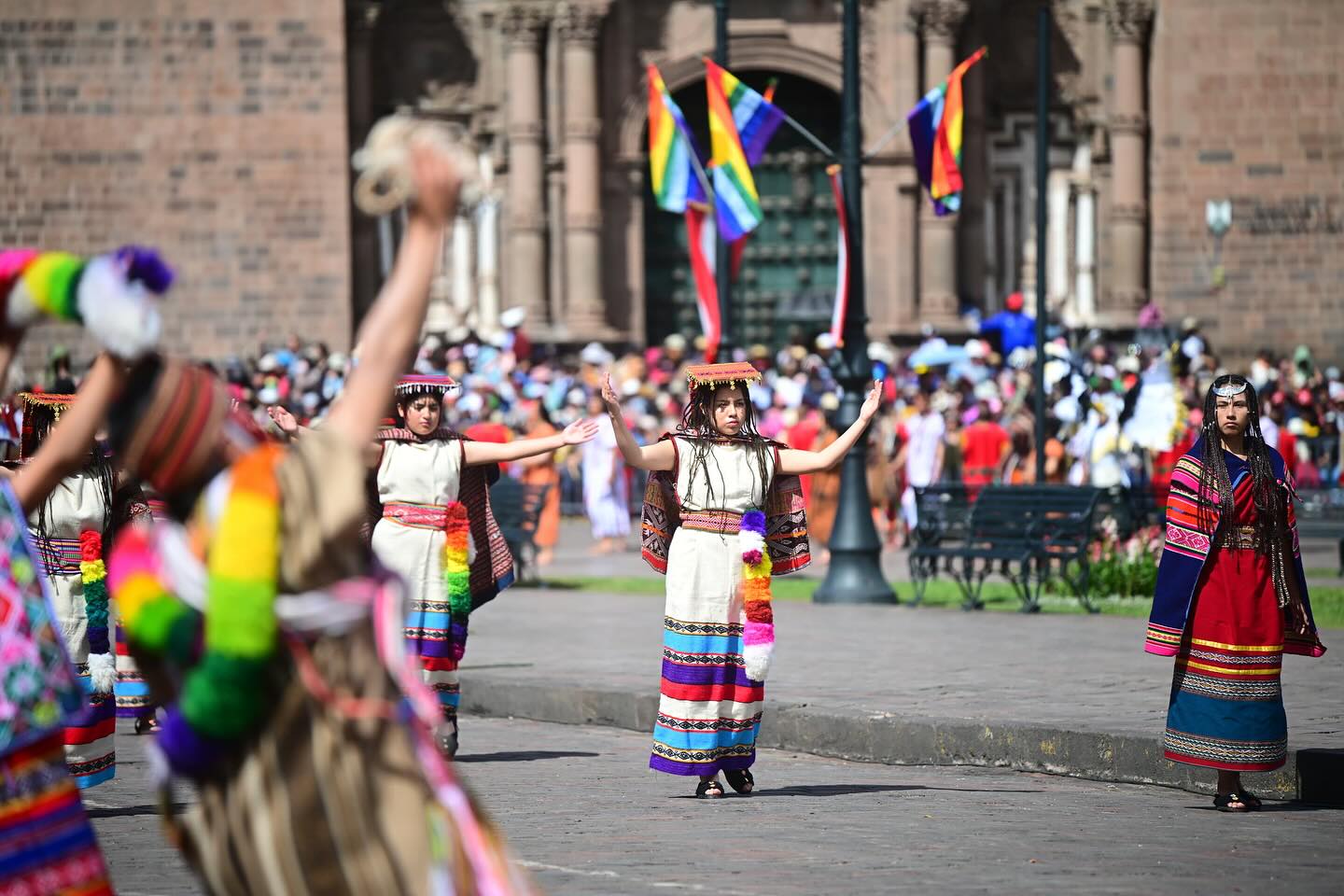
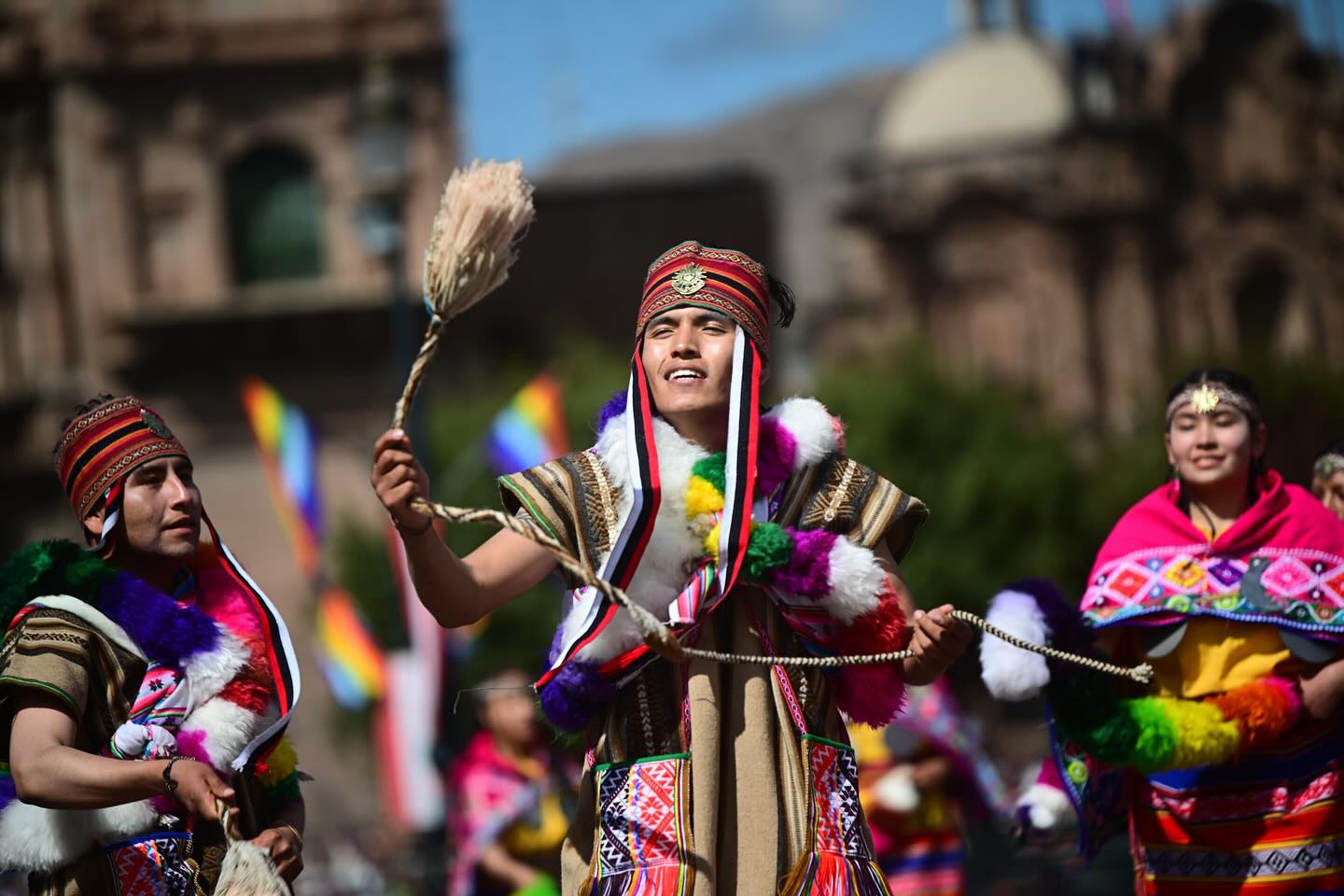
- Inti Raymi live ceremony — once a year, June 24 only. The Festival of the Sun is one of the 10 most spectacular cultural events on the planet. Over 500 performers in authentic Inca dress recreate the ancient winter solstice ceremony in the Quechua language at the fortress of Sacsayhuamán, before 50,000 spectators.
- Reserved grandstand seats — guaranteed and pre-assigned. No queuing, no standing, no searching for a spot in the crowd. Your seat is confirmed before you arrive, offering an unobstructed view of the main stage and central esplanade.
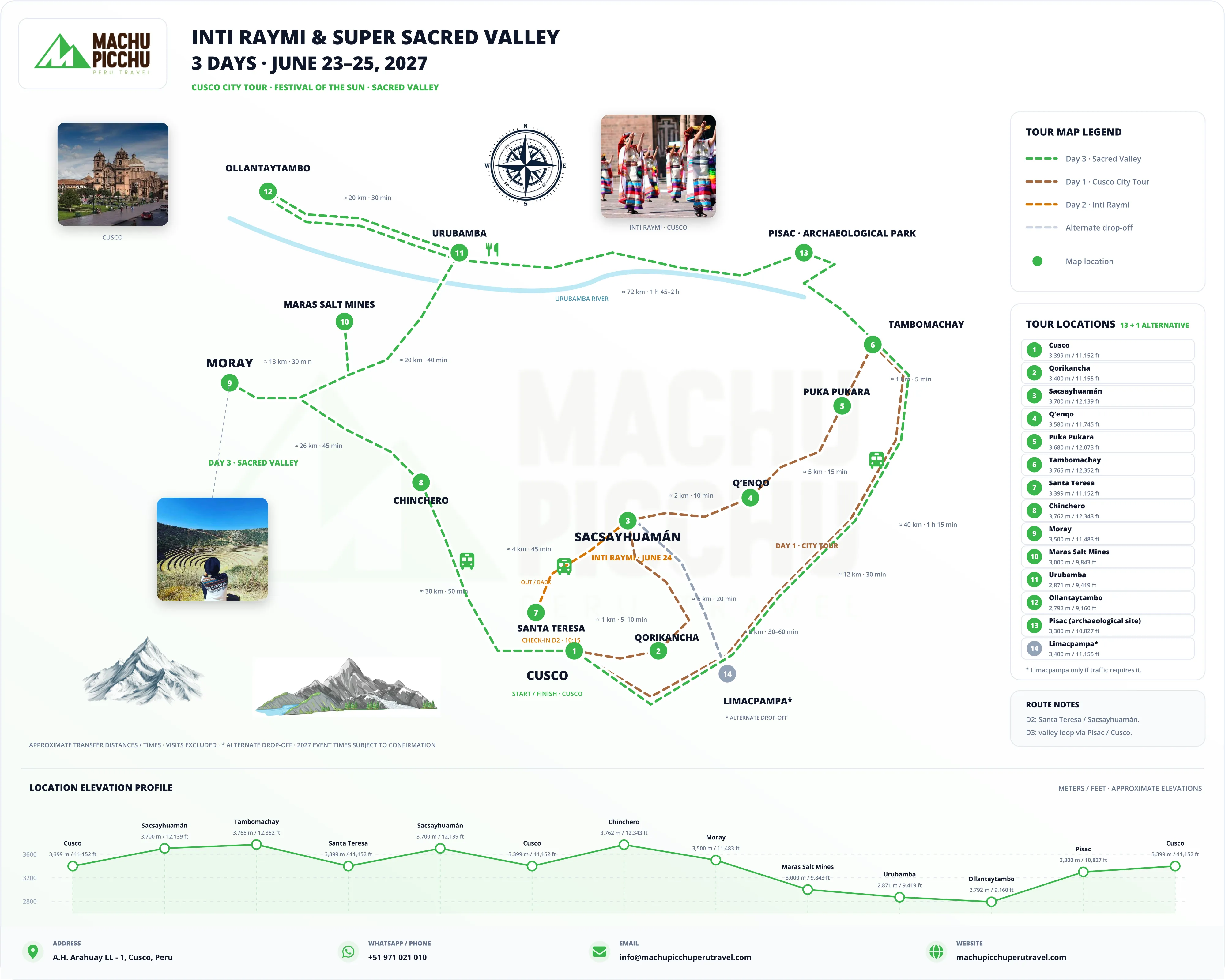
- 7 major Inca archaeological sites in 3 days. Qorikancha, Sacsayhuamán, Q’enko, Puka Pukara, Tambomachay, Ollantaytambo, and Pisaq — all covered with expert guided interpretation.
- Maras Salt Ponds — 3,000 terraced pools in continuous use since pre-Inca times. One of the most visually striking landscapes in all of Peru, where communities still harvest salt by hand using the same techniques as their ancestors 600 years ago.
- Moray — the Inca agricultural laboratory. Circular concentric terraces descending 30 metres with distinct microclimates at every level — believed to be the world’s first experimental crop research station.
- Andean textile workshop in Chinchero. Watch master weavers demonstrate 500-year-old natural dyeing techniques using plants, minerals, and cochineal — and purchase authentic handmade textiles directly at fair prices.
- Ollantaytambo — the only living Inca town in the world. Local Quechua families still live inside the original Inca urban grid, using the same canals and stone channels built over 600 years ago.
- Small groups of maximum 14 people. A quality experience — not a mass tour. Your certified guide has time to answer questions and adapt the pace to the group.
Trip Details
- Tour code CSK-INTI-3D
- Duration 3 days (Day 1 afternoon + Day 2 full day + Day 3 full day)
- Start / End point Your hotel in Cusco historic centre
- Inti Raymi date June 24, 2026 — held once a year
- Max altitude 3,700 m / 12,139 ft (Sacsayhuamán)
- Physical difficulty Moderate — involves walking on uneven Inca stonework
- Group size Maximum 14 participants
- Guide Certified English/Spanish-speaking guide all 3 days
- Transport Private comfortable bus with hotel pickup and drop-off
- Meals Packed lunch included on Day 2 (Inti Raymi only)
- Minimum age 8 years old
- Passport required Yes — original passport required on Day 2 for Inti Raymi registration
Itinerary
Cusco Imperial City Tour
Schedule: Afternoon only · Hotel pickup at 13:00 · Returns approx. 18:00
Your first afternoon in Cusco is a masterclass in Inca civilisation. A certified, English-speaking guide takes you through five of the most significant archaeological sites in and around the city — starting at the most sacred temple in the empire and finishing at a ceremonial aqueduct that has been flowing continuously for 500 years. This afternoon also serves as a perfect preview of Sacsayhuamán, where tomorrow’s Inti Raymi ceremony will take place.
Programme
13:00 — Hotel pickup in Cusco
Your certified guide meets you at your hotel reception in the historic centre of Cusco and provides a briefing on the afternoon’s programme. Private transport departs toward the first site.
13:15 — Qorikancha (Temple of the Sun) · Altitude: 3,400 m / 11,155 ft
Begin at the holiest and most important temple in Tawantinsuyu — the Inca Empire. Qorikancha (“Golden Enclosure” in Quechua) was the most sacred place in the Inca world, once entirely covered in gold sheets and home to the mummified remains of Inca rulers. When the Spanish conquistadors arrived in the 16th century, they built the Convent of Santo Domingo directly over the original structure. Today you can observe both layers simultaneously: the perfectly fitted Inca stonework emerging beneath the colonial arches — a literal architectural collision of two civilisations. The precision of the Inca masonry, achieved without mortar and without iron tools, remains one of the great engineering mysteries of the ancient world.
14:30 — Sacsayhuamán · Altitude: 3,700 m / 12,139 ft
A short drive uphill brings you to the most awe-inspiring construction in Cusco. Sacsayhuamán’s three zigzagging defensive walls are built from limestone blocks weighing up to 120 tonnes — the largest stones in any pre-Columbian structure in the Americas — fitted together with sub-millimetre precision, without mortar, wheels, or iron tools. The panoramic views over all of Cusco from here are extraordinary.
Note: This is the exact venue of tomorrow’s Inti Raymi ceremony. Seeing it today in a calm context helps you understand the scale and layout before the crowds arrive.
15:45 — Q’enko · Altitude: 3,580 m / 11,745 ft
Q’enko (“labyrinth” in Quechua) is a large sacred limestone outcrop carved with serpentine channels, deep niches, and an underground chamber that archaeologists believe was used for ritual sacrifices and possibly the mummification of Inca nobles. Far less visited than Sacsayhuamán, this site has an eerie, atmospheric quality unlike anywhere else in the Cusco region.
16:15 — Puka Pukara · Altitude: 3,600 m / 11,811 ft
The “Red Fortress” — named for the reddish hue of its volcanic stone — served as a military checkpoint and tambo (rest station) on the royal road connecting Cusco to the Sacred Valley. Historians believe it was used to control and register the movement of people and goods entering and leaving the Inca capital. From the upper platforms, there are wide views of the surrounding valleys.
16:45 — Tambomachay (Baths of the Inca) · Altitude: 3,765 m / 12,349 ft
The final stop of the afternoon is Tambomachay — a ceremonial bathing complex with elegantly engineered stone channels that still carry fresh, clean water today, exactly as they have for five centuries. The site was likely used for ritual purification by Inca royalty and members of the court. The sound of running water, the surrounding high-altitude grasslands, and the late afternoon Andean light make this a genuinely peaceful and memorable conclusion to the day.
18:00 — Return to your hotel in Cusco
Private transport drops you back at your accommodation. End of Day 1.
Tonight’s tip: The Plaza de Armas after dark is magnificent — the illuminated Cusco Cathedral and La Compañía de Jesús church are spectacular. Have dinner early, drink at least 2 litres of water, and rest well. Tomorrow is one of the most significant cultural events in South America, and the schedule is tight.
Sites visited on Day 1
- Qorikancha — Temple of the Sun (3,400 m)
- Sacsayhuamán — Great Inca Fortress (3,700 m)
- Q’enko — Sacred Ceremonial Rock (3,580 m)
- Puka Pukara — Red Fortress checkpoint (3,600 m)
- Tambomachay — Baths of the Inca (3,765 m)
Inti Raymi: Festival of the Sun
Date: June 24, 2027 — held once a year
Schedule: Full day · Meeting point 10:15 · Returns approx. 16:30
June 24 is the winter solstice in the Southern Hemisphere — the shortest day of the year and the most sacred date in the Inca calendar. On this day each year, the city of Cusco recreates the Inti Raymi (“Festival of the Sun” in Quechua) — the great Inca ceremony of gratitude and worship to Inti, the Sun God, which the Spanish outlawed in 1535 and which was revived in 1944 as a living act of cultural identity. Today, over 50,000 spectators attend the ceremony at Sacsayhuamán, and 500+ performers in authentic Inca costume deliver a 90-minute ceremonial re-enactment entirely in the Quechua language. It is one of the most powerful cultural spectacles anywhere in the world.
Programme
10:15 – 10:45 — Check-in at Plazoleta Santa Teresa · Altitude: 3,399 m
Our operations team receives you at Plazoleta Santa Teresa for passport registration and group briefing. Bring your original passport — a photocopy is not accepted for access to the reserved grandstand area. Your packed lunch is distributed at this point (no food is sold inside the ceremony grounds).
Essential packing for Day 2: Original passport · Sunscreen SPF 50+ · Wide-brim hat · UV sunglasses · Light waterproof jacket · Warm extra layer · Minimum 1.5 litres of water · Small backpack (large bags are restricted) · Camera / phone fully charged.
10:45 — Departure — Private Inti Raymi bus to Sacsayhuamán
The bus departs punctually at 10:45. No exceptions — please be at the meeting point before 10:30. The 45-minute ride climbs above Cusco, revealing the city’s distinctive Inca grid layout from above. The road to Sacsayhuamán offers sweeping panoramic views of the Andean skyline. No food is available at the ceremony venue — please eat your packed lunch on the bus or before the ceremony begins.
11:30 — Arrival at Sacsayhuamán · Altitude: 3,700 m / 12,139 ft
Pass through security controls (bags are checked). You receive your official Inti Raymi 2026 programme booklet, which contains the complete English translation of the Quechua ceremony dialogue and a detailed explanation of each ritual sequence. Your guide escorts you to your pre-assigned grandstand seats — elevated, covered rows with a clear, unobstructed view of the main stage and central esplanade. Despite the enormous crowds (50,000+ attendees), the organisation is excellent and your experience is calm and comfortable.
13:00 — The Inti Raymi Ceremony begins
The Sapa Inca — played by a distinguished Cusqueño actor selected each year by public audition — is carried onto the stage on a golden throne, accompanied by his royal court in full Inca ceremonial dress. He raises a golden chalice toward the sun and calls upon Inti to accept the gratitude of the Inca people.
Over the following 90 minutes you witness:
- Traditional dances representing the four suyos (regions) of Tawantinsuyu
- Symbolic fire offerings and the lighting of the sacred flame
- The llama offering ceremony — the most sacred moment of the ritual
- Processions of hundreds of costumed performers across the esplanade
- Speeches and prayers in Quechua — translated in your programme booklet
The ceremony is entirely in Quechua, but the visual spectacle is overwhelming — and your booklet provides a complete running translation of everything spoken.
15:00 — Ceremony ends — Guided return to buses
Once the ceremony concludes at approximately 15:00, our staff directs the group efficiently back to the bus loading zone. It is essential to stay with the group at this stage — the crowd of 50,000+ people makes independent navigation extremely difficult and slow. Keep your programme booklet; police may direct traffic at the venue exits, affecting departure timing slightly.
16:30 — Return to Cusco
The bus drops you at Plazoleta Santa Teresa by approximately 16:30. Note: on Inti Raymi day, police frequently redirect traffic due to the volume of departing crowds, which may result in the final drop-off point changing to Plaza Limacpampa (3,400 m), approximately 300 metres from Plazoleta Santa Teresa. Our team will communicate any changes in real time.
The remainder of the evening is free. The streets of Cusco fill with music, dance, artisan markets, and Andean celebration until well past midnight — we strongly encourage you to enjoy it.
Details about Day 2
- Inti Raymi is held once a year — June 24 only. This date cannot be changed.
- Original passport is mandatory for entry to the reserved grandstand area.
- No food vendors operate inside the ceremony grounds. Your packed lunch is provided.
- Altitude at the ceremony venue: 3,700 m / 12,139 ft. Allow for slower pace and deeper breathing.
- Ceremony duration: approximately 90 minutes (13:00 – 15:00).
- Ceremony language: Quechua. Full English translation is in your programme booklet.
- Attendance: approximately 50,000 people. Stay with the group at all times.
Super Sacred Valley Full Day
Schedule: Full day · Hotel pickup at 06:30 · Returns approx. 18:30
The Sacred Valley of the Incas (Valle Sagrado de los Incas) stretches along the Urubamba River between Cusco and Machu Picchu and was the agricultural heartland of the entire Inca Empire. On this full-day circuit you visit six distinct sites — descending from high-altitude plateau villages (3,762 m) all the way down to the warm valley floor (2,792 m) — covering a remarkable diversity of Inca culture, engineering, and landscape within a single day.
Programme
06:30 — Hotel pickup in Cusco
Your guide and private transport collect you from your hotel. Have breakfast before pickup — the first stop is approximately 45 minutes away. The early start allows you to reach Chinchero and Moray before the main volume of day-tour coaches, making for a calmer, more intimate experience at each site.
07:30 — Chinchero — Andean Weaving Village · Altitude: 3,762 m / 12,343 ft
Chinchero is an active Quechua community on the high plateau between Cusco and the Sacred Valley, surrounded by spectacular Inca agricultural terraces and framed by snow-capped mountain peaks. The village is renowned across Peru for its extraordinary textile tradition.
Visit the local weaving cooperative where Quechua women demonstrate the complete natural dyeing process: extracting vivid reds from cochineal (a tiny insect farmed on cactus), yellows from local plants, and blues from minerals — all techniques unchanged for five centuries and passed down through generations of women in the same families. Watch the weaving process on traditional backstrap looms. Authentic, fair-trade handmade textiles are available to purchase directly from the artisans at transparent prices.
Also explore the colonial church of Chinchero, built directly on the foundations of an Inca royal palace — the original Inca stone walls are clearly visible at the base, and the interior contains extraordinary colonial-era murals.
09:15 — Moray — Inca Agricultural Laboratory · Altitude: 3,500 m / 11,483 ft
Moray is one of the most remarkable and thought-provoking sites in the Inca world. A series of circular concentric terraces descend up to 30 metres below the surface of the plateau in enormous bowl-shaped depressions. Archaeological and scientific research has shown that each ring of terraces maintains a distinctly different microclimate — with a temperature difference of up to 15°C between the uppermost and lowest terrace levels.
Scientists and archaeologists believe this was the Inca Empire’s agricultural research station — a living laboratory where crop varieties were tested at different simulated altitudes, helping the Incas develop resilient food systems for every region of their vast empire. The circular geometry is breathtaking from the rim; walking down into the terraces gives a completely different perspective.
10:30 — Maras Salt Ponds (Salinas de Maras) · Altitude: 3,380 m / 11,089 ft
The Salinas de Maras are one of the most visually extraordinary landscapes in all of Peru — and one of the most photographed. Over 3,000 small terraced salt evaporation pools cascade down the hillside above the Sacred Valley, fed by a natural saline spring emerging from the mountain. Salt-laden water flows through a system of channels into each pool, evaporates under the Andean sun, and leaves behind crystalised salt — now often with a pale pink hue from trace minerals.
These salt ponds have been in continuous use since before the Inca Empire and are still actively operated by the local community today. You can observe workers harvesting salt by hand using the same wooden paddles and techniques used for 600 years. The views across the valley from the pond terraces are spectacular.
12:30 — Urubamba — Lunch break · Altitude: 2,871 m / 9,419 ft
Descend to the valley floor town of Urubamba for a lunch break at one of the local restaurants. Most establishments in Urubamba offer a generous buffet lunch featuring traditional Andean dishes — quinoa soup, roast chicken, cuy (guinea pig), local potatoes, and more — for approximately 45–60 Soles per person (not included in the tour price). The lower altitude here provides welcome relief after a morning above 3,500 m.
14:00 — Ollantaytambo — The Living Inca City · Altitude: 2,792 m / 9,160 ft
Ollantaytambo is one of the great wonders of the ancient world and the crown jewel of the Sacred Valley. The site served simultaneously as a royal estate, a religious centre, and a strategic military fortress — and it is the site of one of the few Inca military victories over the Spanish, when Manco Inca successfully defended it against Hernando Pizarro in 1537.
The upper Temple of the Sun features massive pink granite monoliths — each weighing dozens of tonnes — transported from the quarry of Kachiqhata on the opposite mountain face, across the river, and up the steep terraced hillside. The engineering achievement remains extraordinary by any standard.
Below the ruins, the streets of Ollantaytambo are the only surviving example of intact Inca urban planning in the world. Local Quechua families still live inside the original Inca blocks, using water channels, irrigation canals, and stone walls built over 600 years ago. Walking these streets feels genuinely unlike anywhere else.
16:00 — Pisaq — Archaeological Complex · Altitude: 2,972 m / 9,751 ft
Pisaq sits at the northeastern gateway to the Sacred Valley, 33 km from Cusco. The upper archaeological complex is one of the finest examples of Inca terraced agriculture in the entire valley — sweeping tiers of perfectly constructed andenes (agricultural terraces) descend the steep mountainside, still clearly visible after centuries of Andean weather.
The site was a major strategic fortress, astronomical observatory, and ceremonial centre for the Inca Empire. Views from the upper platforms extend across the entire width of the Sacred Valley, with the Urubamba River visible far below and the surrounding mountain peaks — some above 5,000 m — forming a dramatic backdrop. Temperatures here range from 14°C to 20°C (57°F–68°F) — pleasant for late-afternoon exploration. If time allows, the Pisaq artisan market at the base of the ruins offers high-quality local crafts and textiles.
~18:30 — Return to Cusco
Private transport returns you to your hotel in Cusco by approximately 18:30, depending on road conditions and time spent at each site. End of the 3-day programme.
Sites visited on Day 3
- Chinchero — Weaving village and Inca terraces (3,762 m)
- Moray — Inca agricultural laboratory (3,500 m)
- Maras Salt Ponds — 3,000 terraced evaporation pools (3,380 m)
- Urubamba — Lunch stop in the valley (2,871 m)
- Ollantaytambo — Living Inca city and fortress (2,792 m)
- Pisaq — Archaeological complex and valley gateway (2,972 m)
Getting to the Meeting Points
- Days 1 and 3: We pick you up directly at your hotel in Cusco’s historic centre. Confirm your exact hotel address at time of booking.
- Day 2: Meeting point is Plazoleta Santa Teresa, Cusco (3,399 m). Arrive between 10:15 and 10:45. The bus departs at 10:45 sharp — no exceptions. If your hotel is outside the historic centre, please allow extra travel time.
| Notice period before tour start | Refund |
| More than 30 days | 100% refund (minus bank transfer fees) |
| 15–30 days | 50% refund — Inti Raymi seats cannot be resold at this stage |
| 7–14 days | 25% refund |
| Less than 7 days | No refund — Inti Raymi tickets and reserved seats are non-transferable |
| Same day / no-show | No refund |
Important: Inti Raymi grandstand seats are purchased and assigned on a fixed basis and cannot be resold, transferred, or reused. This is reflected in the stricter cancellation terms for this tour compared to other Cusco tours. We strongly recommend purchasing comprehensive travel insurance that covers trip cancellation.
In the event of cancellation by the operator due to force majeure, natural disaster, or government restriction, a full credit valid for 12 months will be issued.
Inclusions
- Private round-trip transport with hotel pickup and drop-off all 3 days
- Certified English/Spanish-speaking guide for all 3 days
- Reserved, pre-assigned grandstand seats at the Inti Raymi ceremony (Day 2)
- Private Inti Raymi tourist bus to and from Sacsayhuamán (Day 2)
- Official Inti Raymi 2026 programme booklet with full English translations (Day 2)
- Packed lunch on Day 2 (no food is sold at the ceremony venue)
- Entrance to Qorikancha (Day 1)
- Entrance to Sacsayhuamán, Q’enko, Puka Pukara, and Tambomachay via Boleto Turístico (Day 1) — assistance provided
- Sacred Valley entrance fees: Chinchero, Moray, Ollantaytambo, and Pisaq (Day 3)
- Maras Salt Ponds entrance fee (Day 3)
- Textile demonstration at Chinchero weaving cooperative (Day 3)
- First-aid kit on board and emergency protocol support throughout
- Small group guarantee — maximum 14 participants
- Hotel accommodation in Cusco (we can provide recommendations on request)
- Flights to and from Cusco
- Lunch on Day 1 (free time in the evening)
- Lunch on Day 3 at Urubamba (approx. 45–60 Soles / USD 12–16 per person)
- Boleto Turístico del Cusco (approximately USD 45 / 170 Soles — if not already purchased)
- Personal travel insurance (required — see FAQ)
- Tips for the guide and driver (greatly appreciated — suggested: USD 5–10 per day per person)
- Altitude sickness medication such as Diamox (consult your physician before travel)
- Personal expenses, drinks, and souvenirs
- Any optional activities not listed in the itinerary
What Travelers Say About this Tour
Our clients trust us, and their glowing reviews on TripAdvisor speak for themselves. Discover why so many travelers choose us for unforgettable experiences in Cusco.
Pricing Options
At Machu Picchu Peru Travel, we offer personalized Cusco City Tour + Inti Raymi + Super Sacred Valley 3 Days, designed to match your interests and preferences. With expert local guides and customized itineraries, explore the beauty of the Andes. Check out our pricing options for a memorable adventure.
SHARE SERVICE
price per person
PRIVATE SERVICE
price per person
About the Inti Raymi — Festival of the Sun
The Inti Raymi (“Festival of the Sun” in Quechua) was the most important religious festival in the Inca Empire — a ceremony of gratitude and worship offered to Inti, the Sun God, held annually on June 24 to mark the winter solstice in the Southern Hemisphere. The Inca calendar was solar, and the winter solstice — the shortest day and the point at which the sun begins to return — was the most sacred moment of the year.
At its historical peak under the reign of Pachacútec (the 9th Sapa Inca, who built much of what we now call Machu Picchu), the Inti Raymi lasted nine days and involved the entire population of Cusco. Thousands of llamas were sacrificed, chicha (corn beer) was offered to the gods, and the Sapa Inca himself led the ceremony at Qorikancha before proceeding to Sacsayhuamán.
The Spanish colonial government banned the Inti Raymi in 1535 as part of the forced Christianisation of the Andean population. For over 400 years, the ceremony existed only in the oral tradition of Quechua communities.
In 1944, Cusqueño playwright Faustino Espinoza Navarro revived the ceremony as a theatrical re-enactment based on the written accounts of the 16th-century Inca chronicler Garcilaso de la Vega. The modern Inti Raymi has been held every June 24 since then and has grown into one of the most attended cultural events in South America, drawing over 50,000 spectators from around the world.
Today the ceremony features over 500 performers in meticulously researched Inca-era costumes, performing a scripted re-enactment entirely in Quechua. UNESCO has recognised the cultural significance of the event, and the Peruvian government has declared it part of Peru’s national cultural heritage.
Inquiry now
Ready to experience Machu Picchu? Let our expert team take care of every detail, from entrance tickets and train arrangements to transportation and guidance, so you can focus on enjoying one of the world most breathtaking destinations. With years of experience, personalized assistance, and hundreds of happy travelers every year, we make your visit simple, safe, and unforgettable. Reserve your Machu Picchu tour today and secure your place at Peru’s most iconic wonder before availability runs out.
Need More Information?
If you have any questions or want to customize your experience, our local travel experts are ready to assist you 24/7.