
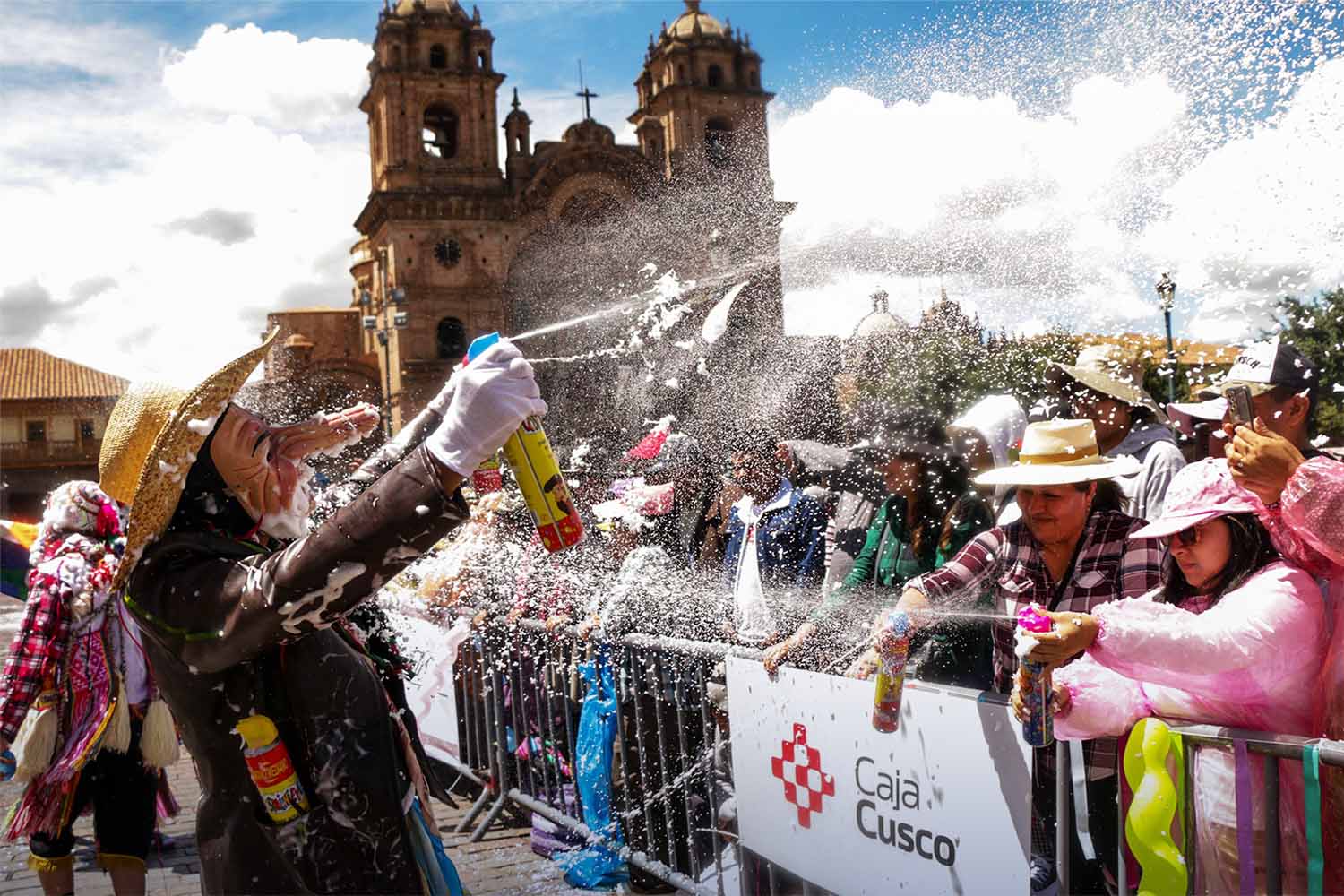
The Cusco carnivals represent a highly anticipated and culturally significant celebration in Peru. This festival occurs between February and March the precise date shifting annually according to the liturgical calendar marking the beginning of a season filled with music dances and ancestral traditions. During this period Cusco at an altitude of approximately 11152 feet or 3399 meters transforms into a hub of joy and color where both locals and visitors participate in activities that emphasize the region’s cultural heritage.
Want to understand the Cusco and Sacred Valley carnivals? Continue reading for a detailed explanation of why these carnivals provide a memorable experience.
The core of the Cusco carnivals
The Cusco carnival is a cultural expression that involves the entire community. The festival starts with preliminary activities in the neighborhoods where groups are organized and traditional dances are rehearsed.
A prominent custom is the “yunza” or “cortamonte” a tradition where a tree decorated with gifts becomes the focal point. The Cusco carnival also features the controlled use of water talcum powder and confetti elements that symbolize purification and renewal adding a vibrant touch to Cusco’s streets. Man those water fights are something else.
Groups organize parades and rehearse traditional performances.
When are the Cusco carnivals 2025?
The Cusco carnivals 2025 will take place on Sunday March 9th in the Plaza de Armas starting at 9:00 AM.
The preliminary festivities include:
- Women’s Day: Thursday February 27th 2025
- Men’s Day: Thursday March 6th 2025
- Kacharpari: Sunday March 16th 2025
The main day (March 9th)
Typically the Cusco carnivals are held in the Plaza de Armas where public and private institutions gather to present a cultural display. Parades groups and traditional dances fill the space with colorful costumes and choreography that reflect the region’s cultural richness.
Many of these groups have won awards at carnival festivals in the Sacred Valley of the Incas and the South Valley ensuring a high-quality spectacle for all attendees.
The infectious rhythms of Andean music huaynos and melodies performed by local bands encourage residents and tourists to join the celebration in a shared festive atmosphere. You know those bands really bring the heat.
The Plaza de Armas becomes the central point of the celebration on the main day of the festival.
Water and paint games
It is customary for young people and adults to engage in water talcum powder and confetti battles a practice that symbolizes purification and renewal.
Parades and contests
Various groups compete in the streets to showcase their best interpretations of dances and costumes.
Yunza or cortamonte
A tree adorned with gifts is placed at the center of the celebration where attendees dance in circles to the rhythm of festive music. With each axe blow anticipation builds until the tree falls at which point participants rush to collect the gifts symbolizing joy and prosperity for the coming year.
A gift-decorated tree is placed at the center of the celebration.
Men’s and Women’s Day celebrations in Cusco
Men’s Day a humorous tribute
On Men’s Thursday women take the lead creating rag dolls that humorously represent men. These dolls called “compadres” are dressed in male clothing often borrowed the previous day and are hung on poles balconies plazas and markets in Cusco.
Accompanied by witty signs the dolls highlight exaggerated or amusing male traits generating laughter and comments among neighbors. The celebration continues with gatherings where women entertain men with music dance and traditional food in an atmosphere of camaraderie and fun.
Women’s Day the festive payback
A week later on Women’s Thursday men return the favor by making rag dolls dressed in female clothing also obtained through playful means. The dolls are hung in strategic city locations accompanied by satirical messages that highlight the qualities or flaws of community women always within a framework of respect and humor.
On this occasion men organize celebrations for women with festivities full of joy traditional music and the tasting of typical Peruvian and Cusco dishes.
The exchange of jokes between men and women symbolizes harmony between both groups as well as the importance of sharing moments of joy and unity before the main carnival. That back and forth is wild.
Closing the Cusco carnivals
The closing of the Cusco carnivals known as kacharpari marks the end of a major and joyful Peruvian festival. In this celebration held on the Sunday following the main day of the Cusco carnival locals and visitors gather again to participate in a day filled with music dances games and traditions that reinforce Andean cultural identity. Streets plazas and neighborhoods become stages for a celebration that represents unity and a hopeful farewell until next year.
A highlight is the repetition of the traditional yunza or cortamonte where a gift-decorated tree is artificially planted in plazas and community spaces. To the rhythm of music attendees dance around the tree cutting it down bit by bit until it falls at which point the gifts are collected by those present. It is always a party with those tree cuttings.
Carnivals in other parts of Cusco
Carnivals are not limited to Cusco city. In its provinces the celebration takes on unique characteristics that enrich the festival with cultural diversity.
- Sacred Valley of the Incas (Pisac Calca Lamay and Urubamba): In these towns the carnival is celebrated with ancestral dances and food fairs where local dishes are sampled.
- South Valley (San Jerónimo Oropesa Tinta): Famous for the Tinta carnival celebration where women take control of the festivities showcasing the strong cultural heritage of the colonial and Inca eras.
- Quillabamba: Due to its warm climate the carnivals include water festivals parades filled with tropical energy and fairs with exotic local products.
What to eat during the Cusco Carnivals?
During the Cusco carnivals a food festival takes place where the region’s most representative dishes can be sampled.
Among the most anticipated is the puchero or t’impu a traditional stew that combines beef and lamb with Andean vegetables such as potatoes cabbage and chickpeas as well as fruits like peaches and pears. This dish full of authentic flavors is considered a symbol of abundance and prosperity. Traditional drinks such as frutillada or chicha de jora made from fermented corn accompany the dishes. That food is the real deal.
Puchero and frutillada at the Cusco carnivals.
Currently this tradition remains alive not only in Cusco’s urban areas but also in rural communities where carnivals are celebrated with a more traditional focus. In the city streets are often decorated with colorful dolls while in older neighborhoods activities such as group competitions and artistic performances in Quechua are organized maintaining the festival’s ancestral essence. I have to admit I am always down for those competitions.
The Cusco carnivals are a celebration that transcends time combining ancestral elements with modern city life. It is an essential experience for those who want to immerse themselves in Andean culture enjoying the music food and joy of a community that keeps its traditions alive.




Leave a Reply