$40.00 USD / personCusco City Tour
A guided introduction to Cusco and its principal nearby archaeological sites.
- Hotel pickup and tourist transport
- Professional English/Spanish guide
- Tourist entrance tickets and Qorikancha entry
- Meals and drinks

Every June 24, Cusco celebrates Inti Raymi, the Festival of the Sun, one of Peru’s most important cultural events. The celebration takes place at Qorikancha, Plaza Mayor and Saqsaywaman, featuring music, traditions and Inca ceremonial performances.
Inti Raymi should be planned as a full-day cultural experience, particularly for passengers who want to follow the celebration from Qorikancha through the historic center and then continue to Saqsaywaman.
Although the main performance at Saqsaywaman lasts approximately three hours, transportation, security controls, walking, waiting periods and movement between the different areas significantly extend the total duration of the day.
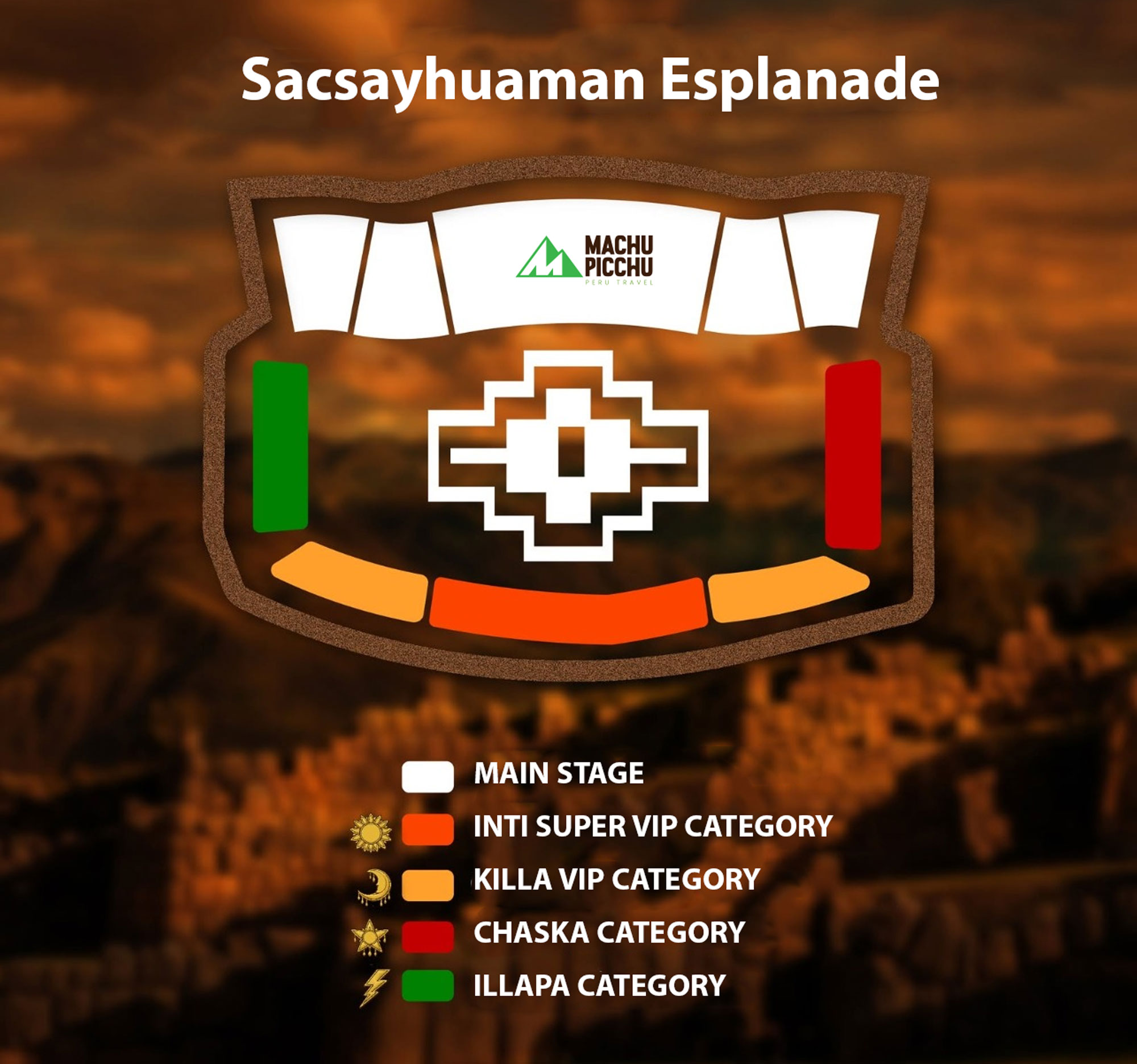
View full map
Select one official Saqsaywaman seating category. You can then add as many optional day tours as you like.
Choose one or several experiences. Every price shown is per person and will update automatically in your package.
$40.00 USD / personA guided introduction to Cusco and its principal nearby archaeological sites.
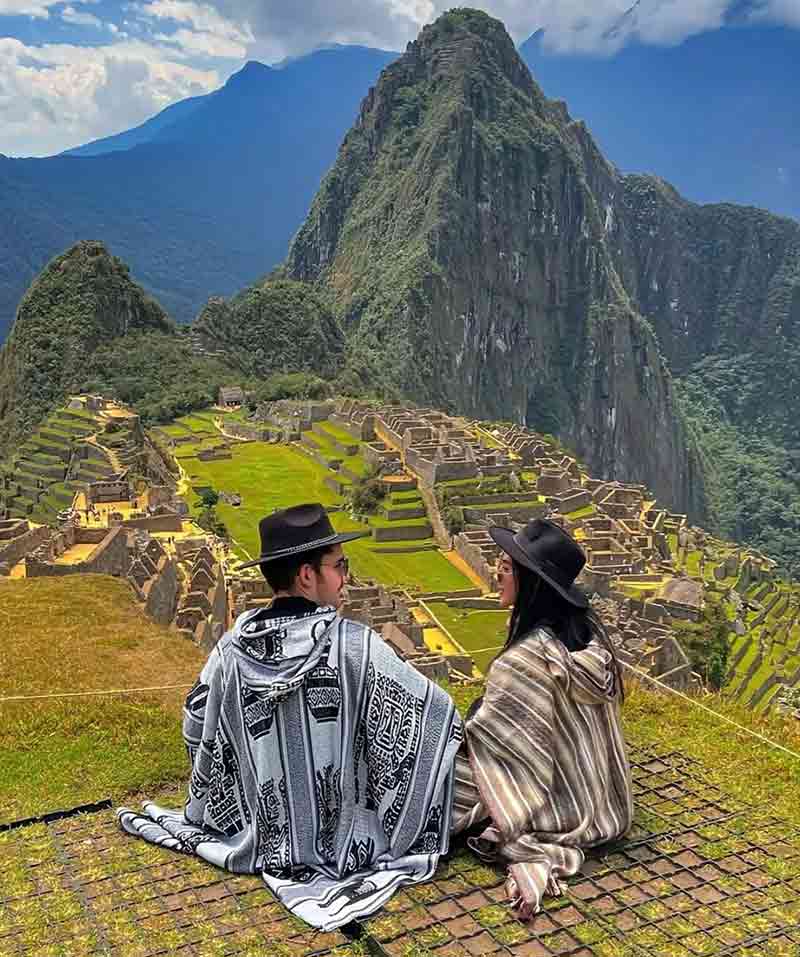
$360.00 USD / personA complete one-day journey from Cusco to Peru’s most iconic Inca sanctuary.
$65.00 USD / personA full-day route through the Sacred Valley’s principal cultural and archaeological sites.
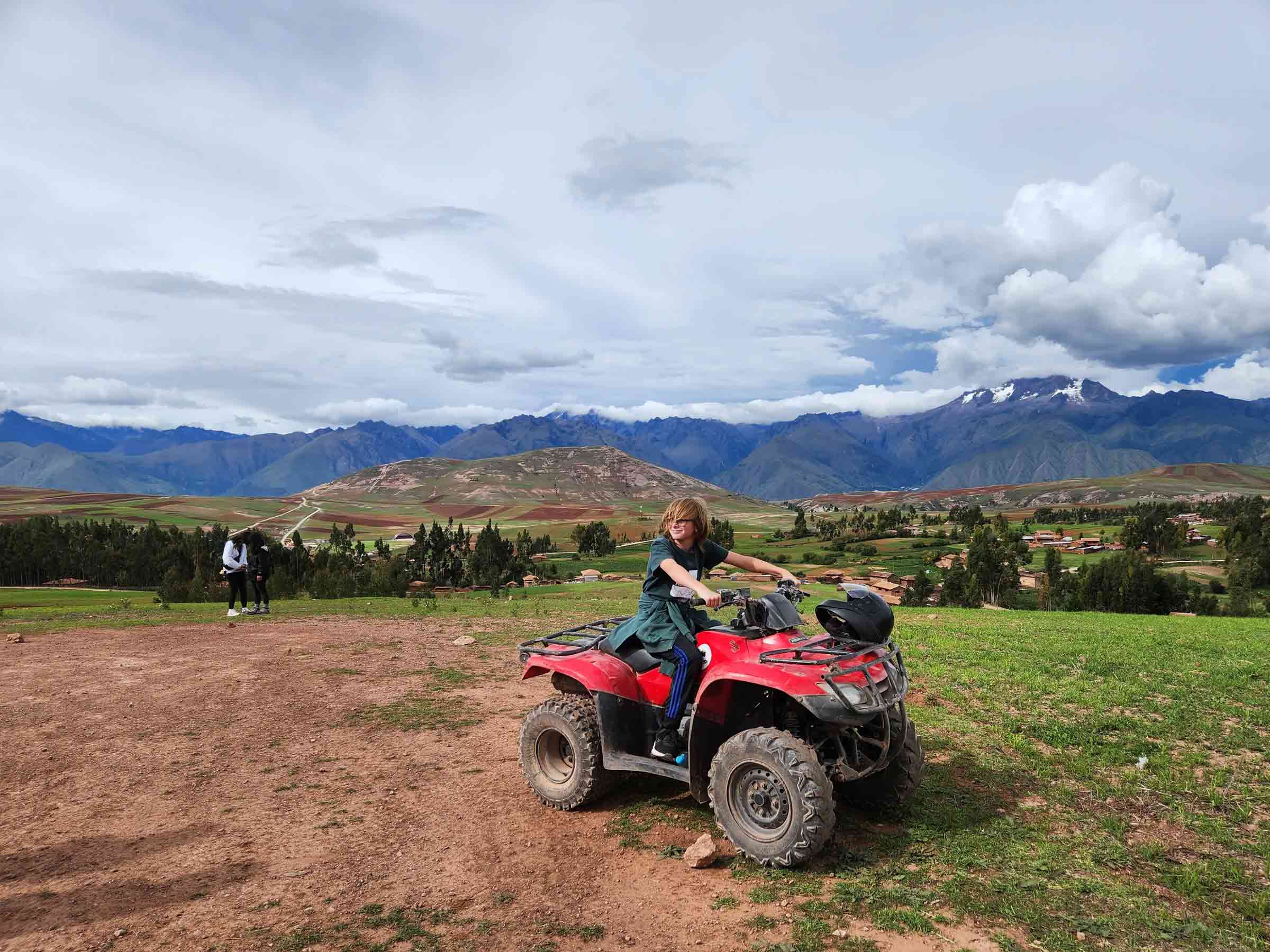
$90.00 USD / personA high-Andes ATV adventure combining Rainbow Mountain and the Red Valley.
$40.00 USD / personA scenic full-day hike to the turquoise Humantay Lake below the Salkantay range.
$40.00 USD / personA full-day high-Andes trek among seven colorful lakes beneath Ausangate.
Qorikancha ceremony
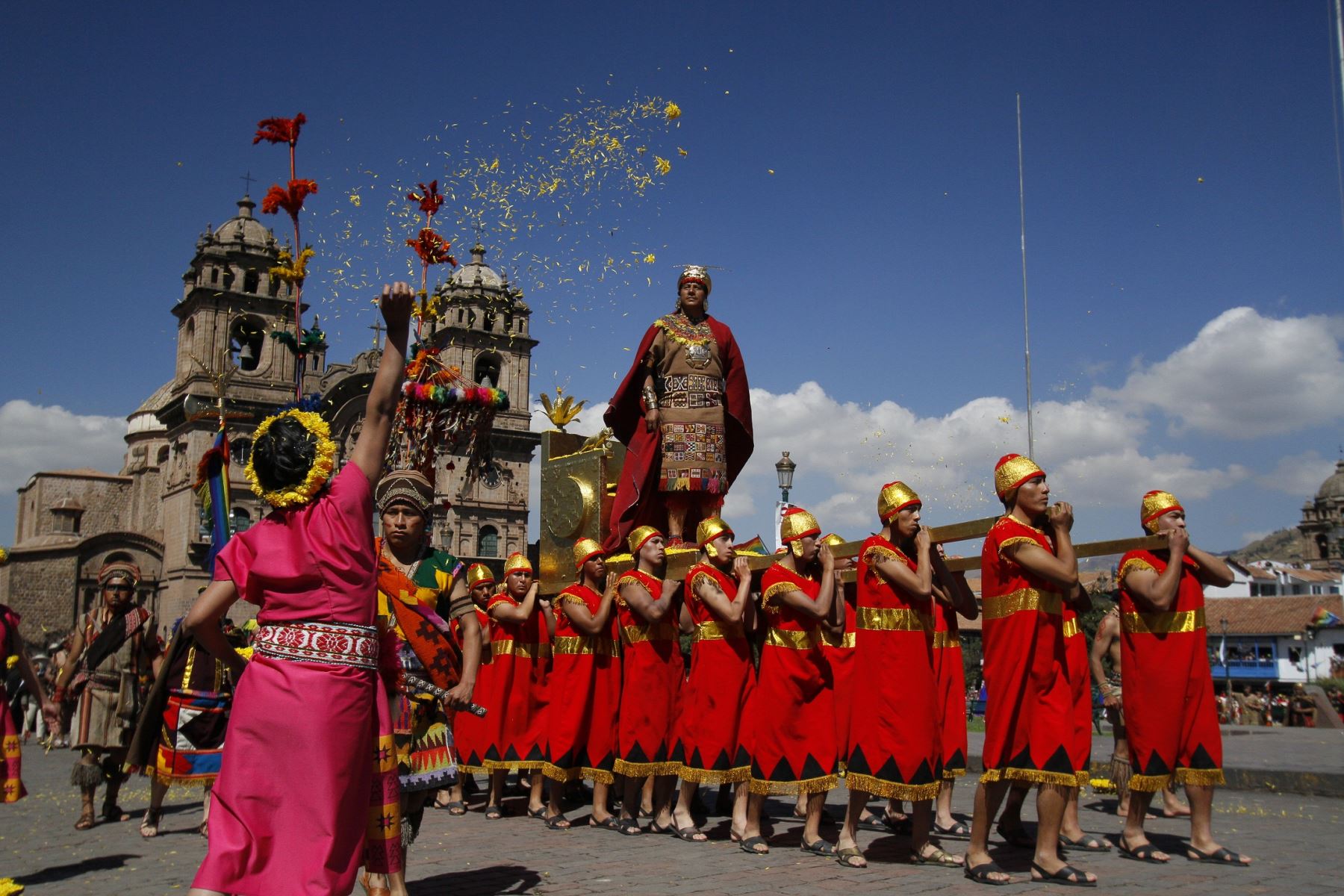
Inca procession
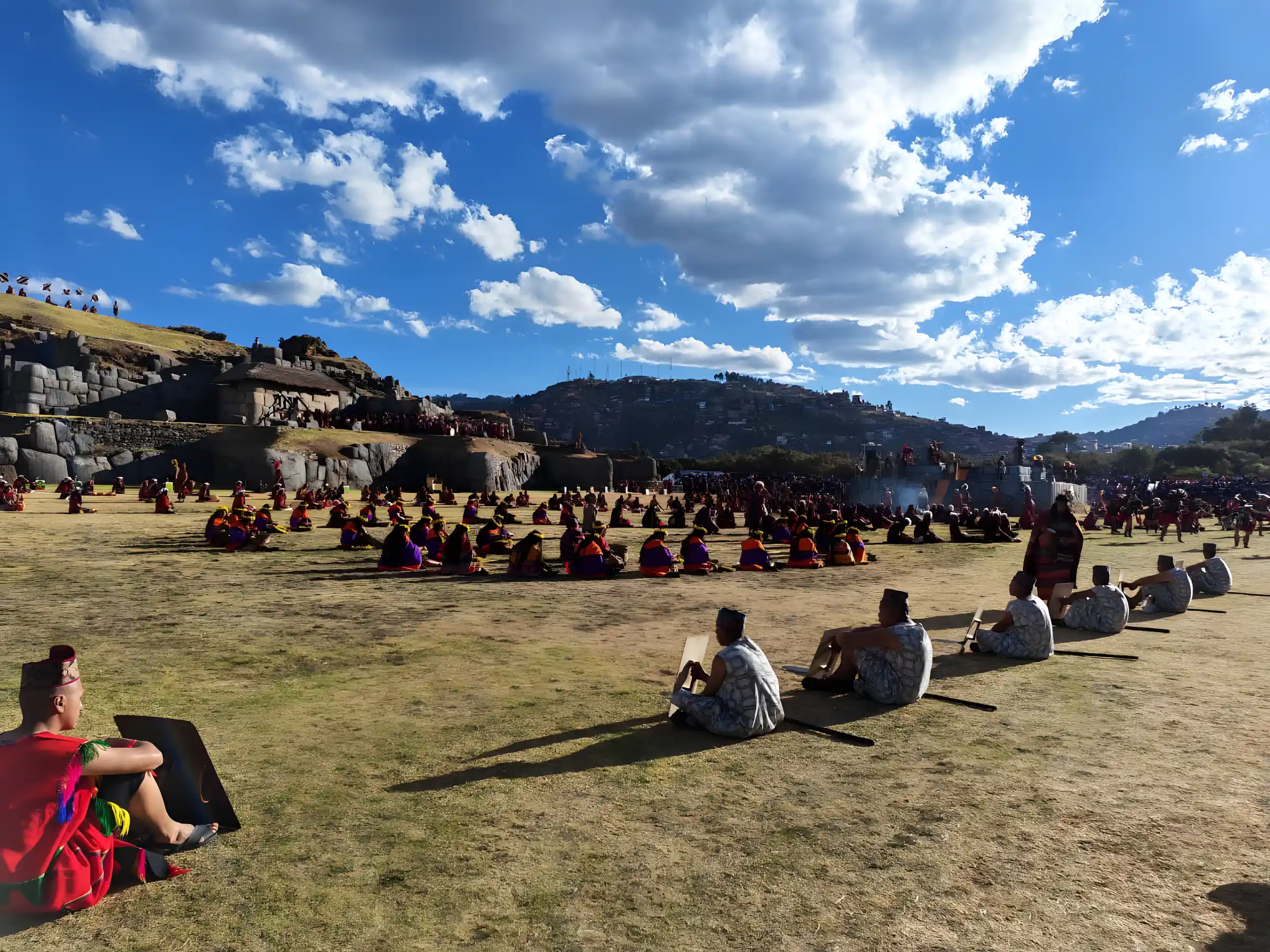
Saqsaywaman stage
Festival costumes
Cusco celebration
Andean music
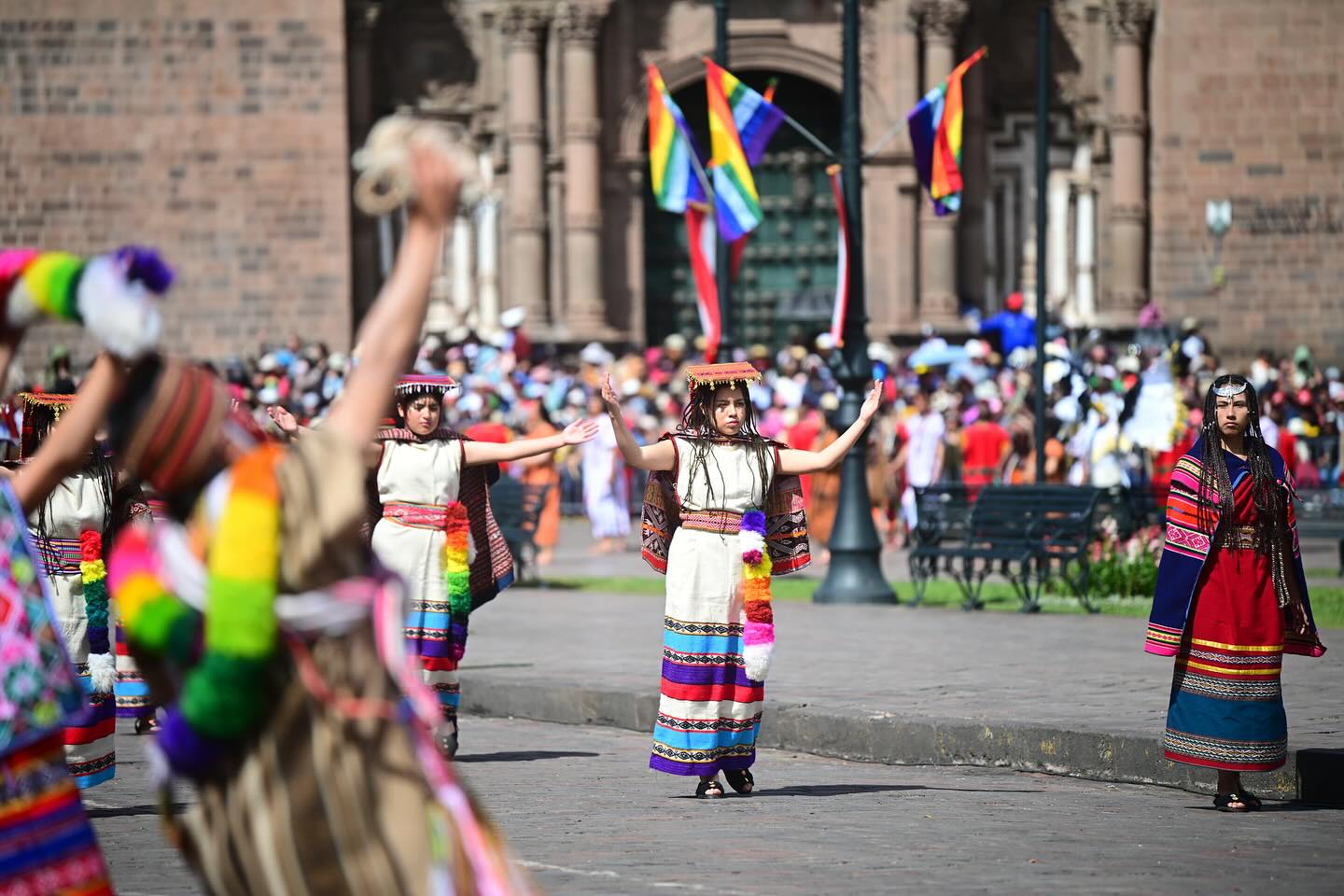
Traditional dancers
Reserved seating
Cusco streets
Festival memory
Inti Raymi means Festival of the Sun in Quechua.
During the Inca period, the Sun was one of the most important divinities of the Tawantinsuyo. The ancient Inti Raymi was associated with the winter solstice in the Southern Hemisphere and marked an important moment in the ceremonial and agricultural calendar.
The celebration honored Inti and expressed the relationship between the Inca state, nature, agriculture, political authority and the sacred world.
The modern Inti Raymi is a cultural reenactment inspired by historical chronicles, rather than an uninterrupted continuation of the ancient imperial ceremony.
It was recreated in Cusco in 1944 and has since developed into one of Peru’s most important cultural events.
Today, hundreds of actors, musicians and dancers represent the Inca, the Qoya, priests, nobles, soldiers and representatives of the four regions of the ancient Tawantinsuyo.
The ceremony combines theatrical representation, Quechua dialogue, music, traditional costumes, symbolic offerings and carefully choreographed processions. For visitors, this provides a visual introduction to the political, ceremonial and spiritual world associated with the Inca Empire.
June is one of the most vibrant months. of the year in Cusco.
The celebration extends far beyond the main Inti Raymi ceremony on June 24. During the weeks surrounding the festival, the historic center becomes the focus of parades, traditional dances, cultural presentations and public celebrations connected with the anniversary of Cusco.
Travelers will notice a completely different atmosphere from an ordinary visit to the city. Streets and plazas become performance spaces, traditional costumes are seen throughout the historic center and thousands of residents participate in celebrations connected with Cusco’s cultural identity.
For travelers interested in history, photography, archaeology and living Andean culture, this period provides an opportunity to combine major archaeological attractions with one of the city’s most important contemporary cultural celebrations.


The Plaza Mayor and surrounding streets become particularly active during June. Parades, dance groups and public celebrations create an atmosphere that cannot be experienced during the rest of the year.
For travelers, this means the city begins telling the Inti Raymi story before the official ceremony starts. Walking through the historic center in the days around June 24 often feels like moving through a living cultural calendar, with music, costumes and local families participating in the wider anniversary celebrations of Cusco.
This context helps visitors understand why Inti Raymi is not only a staged event for tourists, but also part of how modern Cusco remembers, performs and shares its Andean identity.

Visitors can observe groups representing different districts, communities and cultural traditions from the Cusco region. This makes the month of June particularly interesting for travelers who want to experience more than archaeological monuments.
The music and dances create a bridge between the ceremonial language of the main Inti Raymi performance and the living traditions still present in communities around Cusco. The result is a richer visit for passengers who want culture, color and local participation to form part of their Peru itinerary.
Because these expressions appear in plazas, streets and public spaces, they also make June one of the most visually memorable times to stay in the city.

Inti Raymi is theatrical, but the wider celebrations around it also demonstrate how important Andean traditions remain to the cultural identity of modern Cusco.
The ceremony uses Quechua, symbolic offerings, references to the four Suyus and characters connected with the Inca political and sacred world. Seeing these elements in Cusco, surrounded by archaeological sites and colonial architecture, gives the experience a layered historical setting.
For many travelers, this is what makes Inti Raymi different from a conventional show: the city, the mountains, the ruins and the community atmosphere all work together.

Traditional clothing, processions, archaeological settings and the dramatic mountain landscape surrounding Cusco create exceptional photographic opportunities throughout the festival period.
Photographers can capture very different scenes during the day: the tighter urban setting around Qorikancha, the crowds and architecture of Plaza Mayor, and the expansive archaeological backdrop of Saqsaywaman.
Planning matters because the best experience is not only about carrying a camera. Seating category, timing, crowd movement, sunlight and access routes can all influence what visitors are able to see and photograph comfortably.
June is one of the most vibrant months. of the year in Cusco.
The celebration extends far beyond the main Inti Raymi ceremony on June 24. During the weeks surrounding the festival, the historic center becomes the focus of parades, traditional dances, cultural presentations and public celebrations connected with the anniversary of Cusco.
Travelers will notice a completely different atmosphere from an ordinary visit to the city. Streets and plazas become performance spaces, traditional costumes are seen throughout the historic center and thousands of residents participate in celebrations connected with Cusco’s cultural identity.
For travelers interested in history, photography, archaeology and living Andean culture, this period provides an opportunity to combine major archaeological attractions with one of the city’s most important contemporary cultural celebrations.

Around 9:00 AM
The first ceremony takes place at Qorikancha, the Temple of the Sun.
Qorikancha was one of the most sacred temples of the Inca Empire and occupied a central position in the religious organization of ancient Cusco.
The modern Inti Raymi begins here with the appearance of the Inca and his ceremonial entourage.
The location gives the opening performance particular historical meaning because visitors are seeing a representation dedicated to the Sun at the same place where one of the most important temples associated with Inti once stood.
The ceremony is shorter than the principal performance at Saqsaywaman, but it establishes the ceremonial narrative for the rest of the day.
Following the opening rituals, the Inca procession moves toward the Plaza Mayor.
Reserved seating is installed for the event, but capacity is much smaller than at Saqsaywaman.
Because of this limited capacity, Qorikancha can become one of the more difficult parts of the complete Inti Raymi experience to secure.
Travelers attempting to watch from surrounding public areas should also be prepared for crowds and potentially restricted visibility.
Qorikancha is particularly suitable for travelers who want to experience the ceremony from its beginning rather than attending only the grand finale.
It is also attractive for photography enthusiasts because it provides a different visual environment from Saqsaywaman and offers opportunities to photograph the Inca procession closer to the historic center.
Passengers who value comfort, organization and a more predictable view should consider reserved seating rather than relying exclusively on public street viewing.
If your budget is limited and you must choose between Qorikancha and Saqsaywaman, however, we generally recommend prioritizing Saqsaywaman, because it hosts the longest and most important performance.

Around 10:00 AM
The procession continues toward Cusco’s main square, historically known as Hawqaypata.
The Plaza Mayor occupies one of the most important spaces in the historic center of Cusco.
During Inti Raymi, it becomes the setting for the symbolic encounter between the Inca and contemporary Cusco.
The ceremony represents a connection between the city’s Inca past and its modern identity.
One of the symbolic elements of this stage is the presentation of a khipu, recalling the administrative and communicative system used throughout the Tawantinsuyo.
What Should Travelers Expect?
Unlike Saqsaywaman, visitors should not expect the same type of organized reserved seating experience.
The historic center receives very large numbers of spectators, and movement around the Plaza Mayor can become difficult.
Street closures and security controls also mean that normal transportation patterns do not apply.
Visibility depends heavily on where passengers are positioned and how early they arrive.
Travelers should therefore be prepared for long periods standing and for the possibility that their view will be partially obstructed by other spectators.
For this reason, many organized Inti Raymi experiences include only a limited period around the Plaza Mayor before passengers continue toward the logistics required for the main Saqsaywaman ceremony.

Around 1:30 PM
Saqsaywaman is the most important and spectacular stage of the festival.
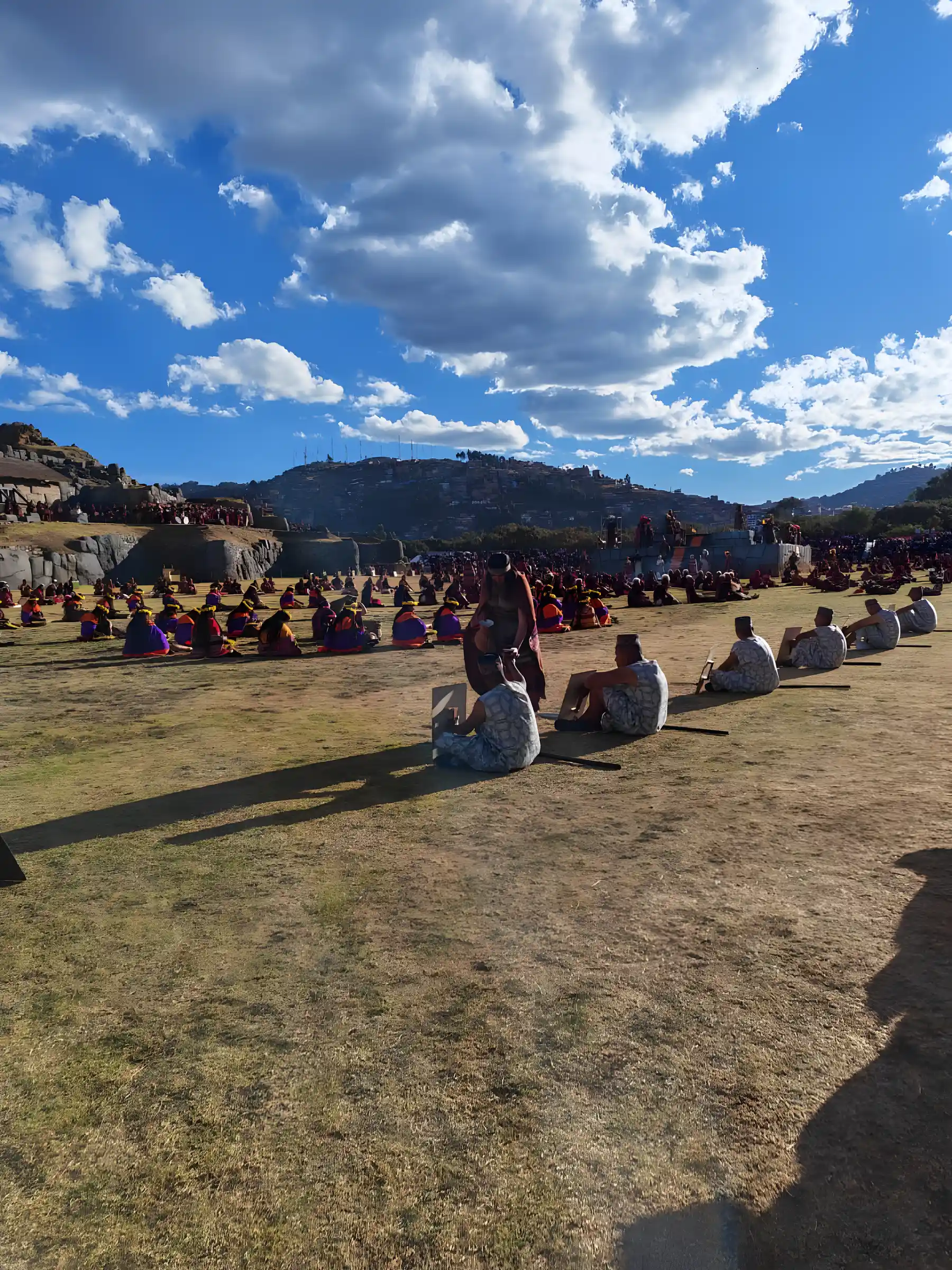
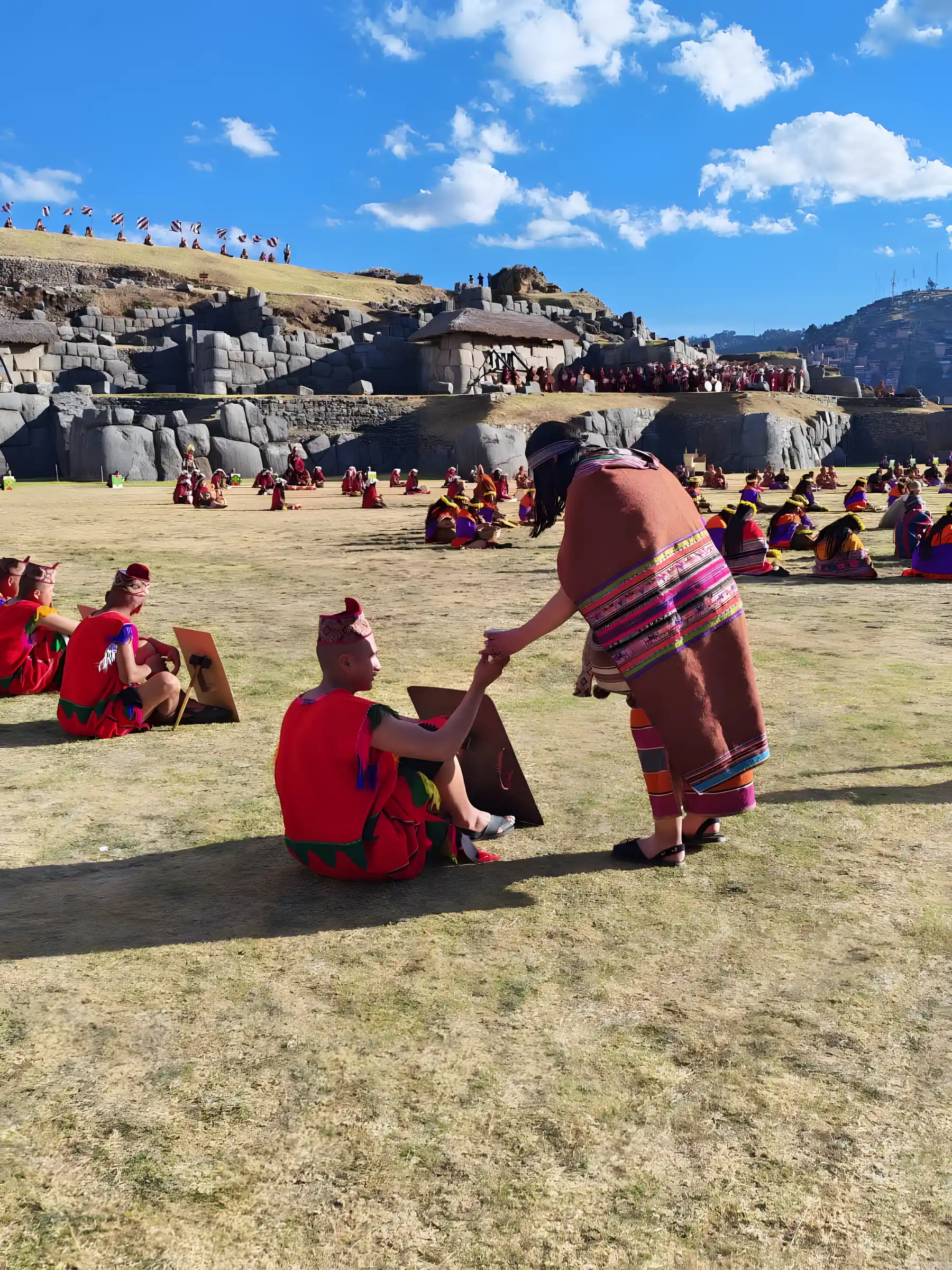
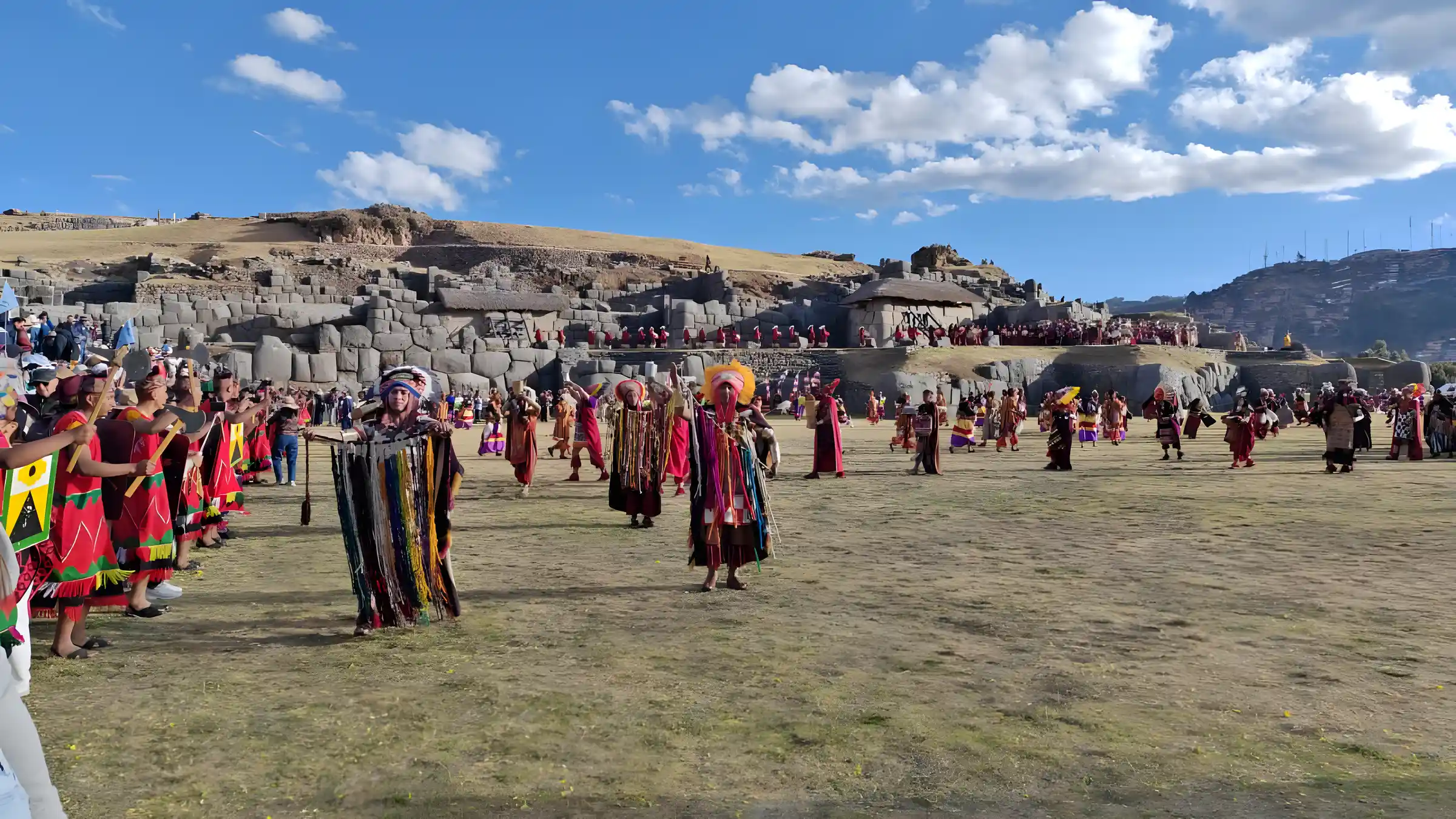
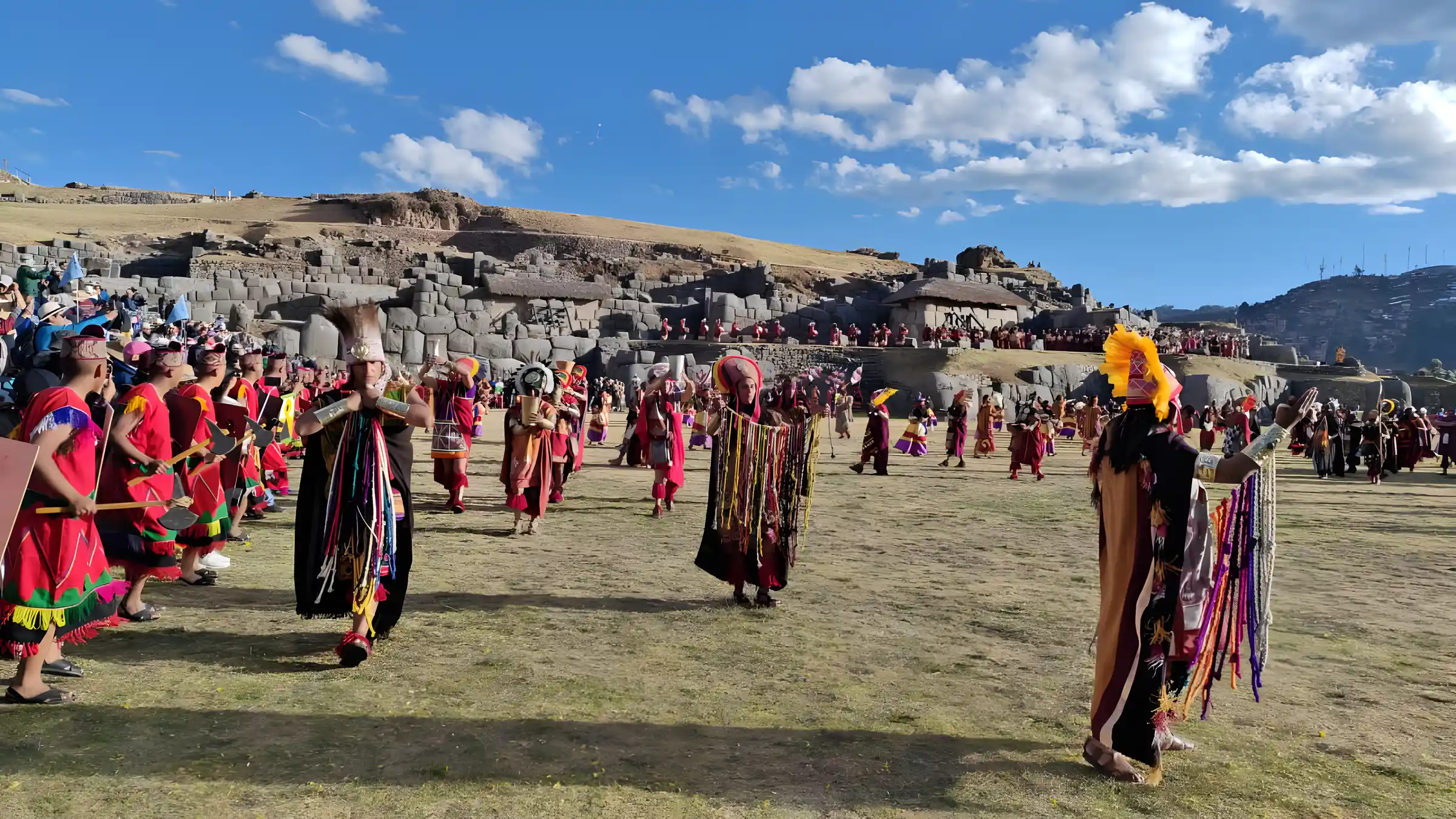
The ceremony takes place on the esplanade beneath the monumental Inca stone walls of Saqsaywaman.
The scale of the archaeological site makes it possible to stage a much larger performance than at Qorikancha or Plaza Mayor.
Hundreds of performers participate in ceremonial sequences representing the political and geographical structure of the Tawantinsuyo.
Representatives enter from the four principal regions:
Chinchaysuyu represented the northern territories of the empire.
Antisuyu extended toward the eastern Andean slopes and Amazonian regions.
Qollasuyu represented the territories extending south from Cusco.
Kuntisuyu incorporated territories toward the southwest.
Understanding these divisions helps visitors appreciate why the arrival of the four Suyus is such an important visual component of the Saqsaywaman performance.
One of the most anticipated moments occurs when the Inca and Qoya enter the ceremonial area accompanied by their entourage.
The combination of traditional costumes, music, hundreds of performers and the enormous stone walls of Saqsaywaman creates the image most travelers associate with Inti Raymi.
The performance incorporates symbolic rituals connected with the Sun, sacred fire, chicha, agricultural offerings and the relationship between the ruler and the four regions of the Tawantinsuyo.
The well-known representation involving a llama is a theatrical and symbolic ceremony rather than an actual sacrifice.
The principal ceremony lasts approximately three hours.
Nevertheless, visitors should consider transportation time, security procedures and entry logistics when planning their day.
For most passengers, Saqsaywaman is the section of Inti Raymi for which purchasing an organized experience provides the greatest benefit.
One of the best ways to understand Inti Raymi is to see how previous travelers experienced the celebration.
Our passenger gallery can show future visitors the atmosphere of June 24, the scale of Saqsaywaman, the crowds, the costumes and the type of memories travelers can expect to take home.
Instead of using only promotional photographs of performers, we recommend including authentic images of your own passengers throughout this section.
These photographs create trust because prospective customers can see real travelers enjoying the same experience they are considering booking.


Booking Inti Raymi involves more than purchasing an entrance ticket.
June 24 is one of the busiest days of the year in Cusco, and visitors must consider ticket availability, meeting points, transportation restrictions, security procedures, timing and the movement of thousands of spectators throughout the city.
Our service is designed to reduce that uncertainty.


Many passengers contact us after finding several ticket names online without understanding the practical differences between them.
We help you evaluate the available categories according to your budget and expectations instead of automatically recommending the most expensive option.
A backpacker, a family with children, a photographer and a honeymoon couple may all need different recommendations.

Ticket availability can change as reservations are confirmed.
Once you decide to proceed, we coordinate the corresponding official entrance category according to current availability and the conditions applicable to the booking.
This saves passengers from trying to coordinate different components separately.

June 24 does not operate like a normal sightseeing day.
Access roads may be restricted, crowds are considerably larger than usual and meeting points must be carefully coordinated.
Working with a local Cusco team gives passengers access to people familiar with these practical conditions.

Seeing Inti Raymi and understanding Inti Raymi are different experiences.
Because much of the performance incorporates Quechua dialogue, symbolism and characters from Inca history, professional interpretation can significantly improve the experience.
A guide provides context about the Inca, the Qoya, the Four Suyus and the ceremonial sequences taking place in front of you.

Transportation is one of the most important logistical considerations on June 24.
Normal road access can be altered by closures and large numbers of pedestrians.
Depending on the package selected, coordinated transportation can remove one of the main difficulties passengers would otherwise have to manage independently.

Before the event, passengers receive practical instructions about meeting times, locations, clothing, tickets and what to bring.
Having this information before June 24 allows you to enjoy the festival instead of spending the morning trying to understand where you need to go.
We try to keep the booking process simple while making sure passengers understand what they are purchasing.
Send us your number of passengers, preferred category, travel dates and any special requirements.
If you are not sure which category to choose, you can simply tell us your approximate budget and priorities.
Because entrance inventory is limited, we verify the corresponding availability before confirming your selected option.
If your first choice is unavailable, we can explain the closest alternatives instead of leaving you to compare categories independently.
Once the appropriate option has been identified, you receive the booking information and payment instructions.
Your reservation should only be considered confirmed when the required booking process has been completed.
After confirmation, we coordinate the official ticket associated with your booking according to the service purchased.
Before Inti Raymi, you receive practical information about your meeting time, meeting point, transportation arrangements and what to expect during the day.

Inti Raymi happens only once each year.
This makes booking behavior very different from ordinary Cusco day tours, which often have multiple departures throughout the year.
Passengers with fixed dates should avoid assuming that their preferred seating category will still be available shortly before June 24.
Booking early becomes especially important if you are traveling:
The earlier you plan, the more choices you are likely to have.

A cheaper offer may include fewer services.
Before choosing between tour operators, compare entrance category, transportation, guide service, assistance and meeting-point logistics.
June 24 is fixed and cannot be moved to another day.
If your preferred category sells out, the only alternatives may be another seating category or a different type of experience.
Once ticketing processes are completed, changes may be restricted.
Review your preferred option before payment instead of assuming you can upgrade or change seats later.
Cusco receives strong demand around Inti Raymi.
Central hotels can be particularly useful because passengers may be able to avoid some transportation difficulties created by road closures.
Cusco is approximately 3,400 meters above sea level and Saqsaywaman is even higher.
If possible, avoid arriving late on June 23 and expecting to spend the following day comfortably participating in a full-day festival.
A few days in Cusco before Inti Raymi can make the experience significantly more comfortable.

Preparing correctly can make June 24 much more enjoyable.
Cusco mornings can be cold, while direct sunlight during the middle of the day can feel strong.
Layered clothing is therefore the most practical option.
A light base layer, fleece or sweater and wind-resistant jacket allow you to adjust as temperatures change.
Comfortable walking shoes are also important because passengers may need to walk through pedestrianized and archaeological areas.
Cusco’s high altitude increases exposure to strong ultraviolet radiation.
Bring sunscreen, sunglasses and a sun hat even if the morning feels cold.
Carry enough water for the parts of the day when purchasing drinks may be inconvenient.
Personal medication, identification, your ticket information and a portable phone charger are also useful.
Try to travel with a small daypack rather than unnecessary large luggage.

Children can enjoy Inti Raymi, particularly because the colorful costumes, music and large ceremonial processions are visually engaging.
However, parents should consider that the complete experience involves high altitude, substantial crowds and several hours of performances.
For younger children, concentrating primarily on Saqsaywaman may sometimes be more comfortable than trying to follow every stage from early morning.
Reserved seating is also generally easier for families than relying on public viewing areas where children may struggle to see above the crowd.

Older travelers can enjoy Inti Raymi, but comfort and logistics become especially important.
We recommend arriving in Cusco several days before the event, choosing reserved seating and minimizing unnecessary walking.
Travelers with existing mobility concerns should inform us before booking so we can provide more realistic advice about the selected experience.
The archaeological environment around Saqsaywaman includes uneven ground and elevation, so passengers should not assume it offers the same accessibility as an indoor theater.

The suitability of Inti Raymi depends on the passenger’s individual mobility.
Saqsaywaman is an archaeological site rather than a purpose-built modern venue, and visitors may encounter uneven surfaces, slopes and crowded access areas.
If anyone in your party has difficulty walking long distances, climbing steps or remaining seated outdoors for extended periods, let us know before purchasing tickets.
This allows us to help determine whether the proposed service is appropriate rather than discovering limitations on the day of the event.
Videos can help travelers understand the differences between the three stages before choosing their package.
The Qorikancha video should demonstrate how the festival begins, the proximity of the ceremony to Cusco’s historic center and the appearance of the Inca before the procession continues through the city.
This video can show passengers the size of the crowds, the historic urban setting and the atmosphere surrounding the Encounter of the Times.
It is particularly useful for helping visitors understand why viewing conditions here differ from reserved seating at Saqsaywaman.
The Saqsaywaman video should emphasize the size of the main performance, the hundreds of participants and the impressive archaeological setting.
For undecided passengers, this is generally the most important video because it shows the ceremony associated with the paid grandstand experience.
Inti Raymi works particularly well as the cultural centerpiece of a larger Cusco itinerary. Rather than planning your trip around the festival alone, you can combine June 24 with visits to Machu Picchu, the Sacred Valley, Rainbow Mountain, Humantay Lake, or even a multi-day trek such as the Salkantay Trek or the Inca Trail. Exploring these destinations before or after Inti Raymi allows you to experience different sides of the region, from Inca archaeological sites and traditional Andean communities to dramatic mountain landscapes. It also gives you more flexibility when organizing transportation, accommodation, and acclimatization, which is especially important during June, one of the busiest travel periods in Cusco.


Machu Picchu is the most natural addition to an Inti Raymi journey.
Experiencing the Festival of the Sun in Cusco provides useful cultural context before or after visiting the most famous Inca archaeological site.
Because Machu Picchu entrance tickets and trains can also be subject to strong demand, travelers visiting during June should organize both experiences well in advance.

The Sacred Valley is particularly recommended before Inti Raymi.
Places such as Pisac and Ollantaytambo help passengers understand the scale and organization of the Inca world before seeing those ideas represented ceremonially on June 24.

A City Tour before Inti Raymi is useful because passengers can visit Qorikancha and Saqsaywaman under normal conditions first.
When they return during the festival, they have a much stronger understanding of how the spaces have been transformed for the ceremony.


For many first-time travelers, a well-paced trip could look like this:
Day 1 – Arrival in Cusco
Use your first day to rest, explore the historic center slowly and begin adjusting to the altitude.
Day 2 – Cusco City Tour
Visit Qorikancha, Saqsaywaman and other important sites to understand the historical setting before the festival.
Day 3 – Sacred Valley
Explore the wider Inca landscape and important archaeological sites outside Cusco.
Day 4 – Inti Raymi
Dedicate the entire day to the Festival of the Sun.
Day 5 – Continue Toward Machu Picchu
Travel through the Sacred Valley toward Aguas Calientes or follow the transportation arrangement included in your itinerary.
Day 6 – Machu Picchu
Complete your cultural journey with a guided visit to Machu Picchu.
This sequence provides historical context before Inti Raymi while avoiding too many demanding high-altitude activities immediately before June 24.
Frequently Asked Questions About Inti Raymi
Inti Raymi is celebrated every year on June 24 in Cusco.
The date does not move according to the day of the week, so passengers planning specifically for the festival should organize flights and accommodation around June 24.
The official celebration progresses through three principal locations:
Qorikancha, where the ceremony begins.
Plaza Mayor or Hawqaypata, where the procession continues through the historic center.
Saqsaywaman, where the largest and longest ceremony takes place.
For most international travelers, Saqsaywaman is the principal event.
It hosts the longest performance, the largest number of actors and the ceremonial sequences most commonly associated with Inti Raymi.
If you have limited time or budget and can choose only one paid experience, Saqsaywaman is generally the section we recommend prioritizing.
You can observe portions of the festivities in public areas of Cusco without purchasing reserved seating.
However, public viewing is subject to very large crowds and visibility cannot be guaranteed.
Travelers who want to comfortably experience the principal Saqsaywaman ceremony should purchase an official reserved seating option.
Yes, some parts of the celebration can be seen from public areas.
However, this should not be confused with the experience of having a confirmed seat inside the official Saqsaywaman grandstands.
Free viewing normally means arriving early, standing for long periods and accepting that other spectators may obstruct your view.
There is no universally best category.
Illapa is suitable for travelers prioritizing value.
Chaska offers a strong balance between price and experience.
Killa VIP is recommended for passengers looking for a premium upgrade.
Inti Super VIP is intended for travelers who want the highest available experience level.
For many first-time visitors, Chaska provides the strongest balance.
It is positioned above the entry-level category without requiring passengers to move immediately to the highest premium price.
However, our recommendation can change depending on availability and the passenger’s budget.
It depends on how important Inti Raymi is to your overall trip.
If you are traveling primarily to see the festival, value photography highly or are celebrating a special occasion, upgrading can make sense.
If your budget must also cover Machu Picchu, hotels and several additional tours, a standard category may provide better overall value.
Yes, but parents should consider the length of the day, high altitude, strong sunlight and large crowds.
For younger children, a Saqsaywaman-focused experience with reserved seating may be easier than attempting every stage from early morning.
Yes.
Many older travelers enjoy the festival successfully.
The most important considerations are altitude acclimatization, appropriate seating, transportation and mobility.
Passengers with significant mobility limitations should discuss them with us before booking.
Access during Inti Raymi can be more complicated than during a normal archaeological visit because of road controls, crowds and security procedures.
This is one of the main reasons many travelers prefer an organized tour with coordinated transportation.
An official entrance ticket and an organized tour package are not necessarily the same product.
Transportation depends on the package you purchase.
Always check your booking confirmation carefully to understand whether transportation is included.
A guide is not required simply to sit in the grandstand, but we strongly recommend professional guiding for passengers interested in understanding the performance.
Much of the ceremony uses Quechua, and many characters and rituals have meanings that are not obvious without cultural context.
Much of the ceremonial performance uses Quechua.
This contributes to the authenticity and cultural character of the performance but also means international visitors may benefit significantly from a guide who can explain what is happening.
The Saqsaywaman ceremony lasts approximately three hours.
Passengers following the complete experience from Qorikancha should consider Inti Raymi a full-day activity.
Travelers attending the complete experience should expect an early morning start.
The exact meeting time depends on the package, ticket arrangement and logistical conditions established for the event.
Final instructions are normally provided before June 24.
If June 24 is one of the main reasons for your trip, booking several months in advance is recommended.
Travelers wanting specific premium categories, Qorikancha tickets or larger group reservations should plan particularly early.
Yes.
The official seating capacity is limited and the festival occurs only once per year.
Certain categories may therefore become unavailable before others.
Passengers should not assume that ticket categories can be changed after issuance.
Because event tickets may be subject to strict conditions, choose your preferred category carefully before confirming payment.
Official entrance tickets normally have restrictive cancellation and refund conditions.
Once tickets have been purchased and issued, they may become non-refundable or non-changeable according to the applicable event conditions.
Other components of your tour may have separate cancellation policies.
If your first option is unavailable, we can help you compare the remaining categories.
For example, a passenger requesting Chaska may decide that the additional amount for Killa VIP is worthwhile, or may prefer Illapa to remain within budget.
We help you evaluate the alternatives rather than simply telling you that your original choice is unavailable.
Passengers should carry the identification required for their ticket and reservation.
We recommend bringing the same valid identification used for the booking whenever possible.
Wear comfortable layered clothing.
Cusco mornings can be cold while midday sunshine can feel strong.
Comfortable walking shoes, a fleece or sweater, a light jacket, sunglasses, sunscreen and a sun hat are recommended.
June falls within Cusco’s generally drier period, but mountain weather can never be guaranteed.
Passengers should still be prepared for changing temperatures and occasional unexpected conditions.
Personal cameras and smartphones are normally part of the visitor experience.
However, specialized professional equipment, commercial filming or restricted equipment may be subject to different rules.
For travelers interested in Inca history, traditional culture, photography and major cultural events, Inti Raymi can be one of the highlights of a trip to Peru.
What makes the experience particularly special is that it cannot simply be postponed to another day.
Unlike Machu Picchu or the Sacred Valley, which can be visited throughout much of the year, Inti Raymi takes place only on June 24.
Either option can work.
However, many travelers enjoy visiting Cusco and the Sacred Valley before Inti Raymi because the historical context helps them understand the festival better.
Machu Picchu can then become the final major experience of the journey.
We recommend allowing several days rather than traveling to Cusco only for June 24.
A stay of approximately five to six days makes it easier to acclimatize, experience Inti Raymi and include important attractions such as the Sacred Valley and Machu Picchu.
Yes.
You do not need to understand every category before contacting us.
Tell us:
We can then recommend the option that best matches your trip and current availability.
Before confirming your Inti Raymi reservation, consider what kind of experience you actually want.
If your priority is simply to attend the main ceremony with a reserved seat, Illapa may be enough.
If you want an improved experience while remaining conscious of cost, Chaska may provide the best balance.
If Inti Raymi is a major reason for traveling to Peru, consider Killa VIP or Inti Super VIP.
Also decide whether you want only Saqsaywaman or whether witnessing the opening ceremonies at Qorikancha is important to you.
Finally, remember that the success of the day depends on more than the ticket itself. Transportation, guiding, meeting-point coordination and local assistance can be just as important on one of Cusco’s busiest days of the year.
Inti Raymi is one of the most important cultural experiences available in Cusco, but it is also one of the events that benefits most from advance planning.
Our goal is not simply to sell you an entrance category.
We want to help you choose an experience that makes sense for your budget, travel style and expectations.
From identifying the right seating category to coordinating tickets, guiding and transportation according to your selected package, our local team can help make June 24 easier to organize.
Whether you choose Illapa, Chaska, Killa VIP or Inti Super VIP, you will be participating in a celebration that transforms Cusco for one extraordinary day each year.
Tell us your travel dates, number of passengers and preferred type of experience.
If you already know which category you want, we can help you check the corresponding option.
If you are still deciding, tell us what matters most to you and we will help you compare the available alternatives before you book.